
How QuickBoard compares.
QuickBoard puts cognition, reaction, and weight-bearing movement on one sensor board, and it trains there, not just tests. Reaction lights, force plates, wall-mounted reaction boards, and screen-based cognitive training each answer a different question. The hardware costs $2,295 or $2,495, one time, plus software from $49.99 to $199.99 a month. Here is where each tool is strong, and where QuickBoard is different.
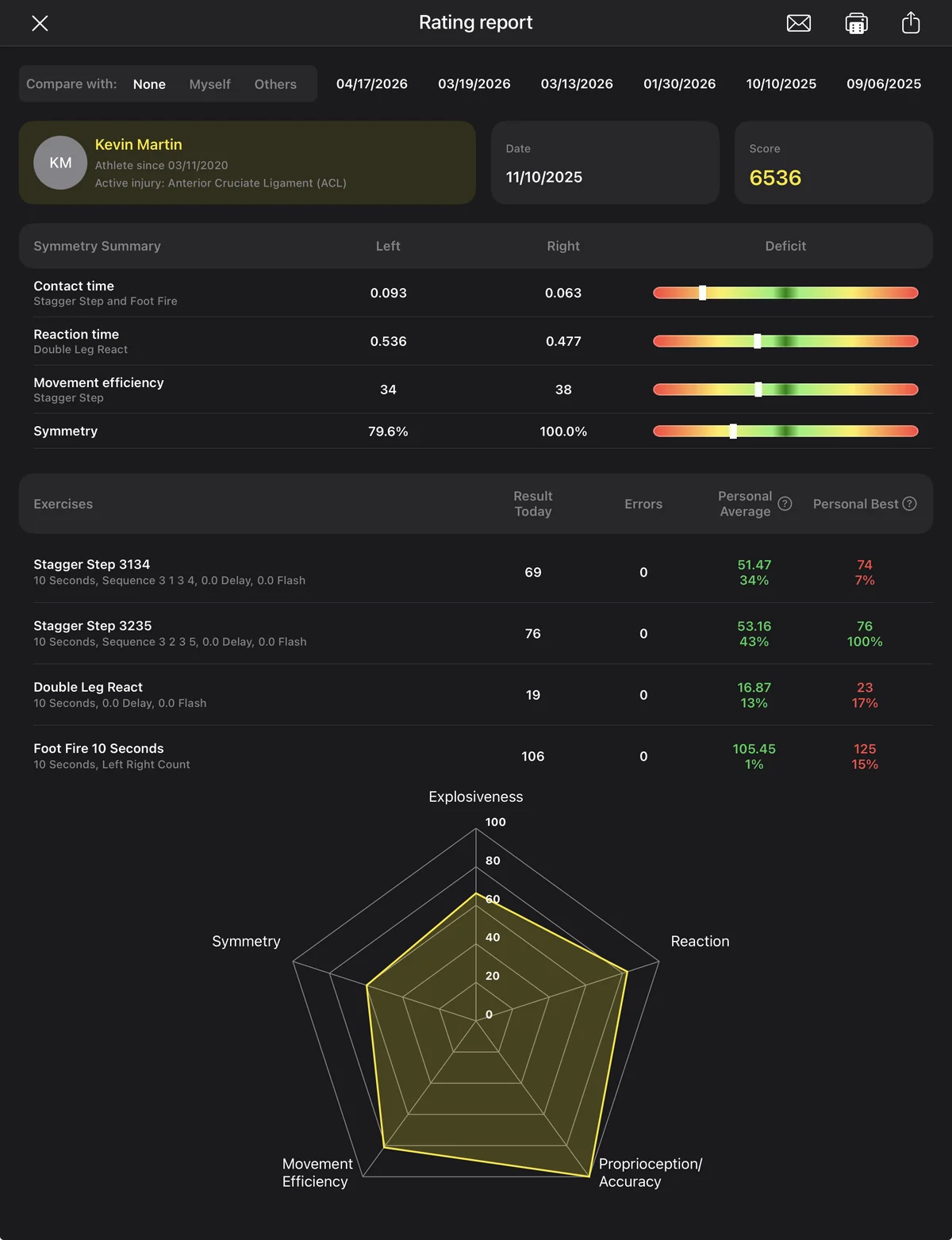
QuickBoard is a floor sensor board paired with an iPad app. The patient or athlete stands on the board at full body weight. Targets appear on an eye-level screen, which keeps attention on an external focus. Every rep records reaction time and ground contact time for each leg. The app runs pre-built protocols and writes PDF reports, including CPT 97750 documentation. Many clinics use QuickBoard alongside one or more of the tools below.
How is QuickBoard different from each tool?
| Tool | Built for | What QuickBoard adds |
|---|---|---|
| Portable reaction lights | Reactive drills that travel, in the clinic or on the field | Full body weight, per-leg contact and reaction time, Stroop tasks, and a billable PDF report |
| Force plates | Measured force: jump biomechanics, impulse, peak power | Reaction time under a cognitive cue and per-leg contact time. QuickBoard jump force and power are estimated, not measured |
| Wall-mounted reaction boards | Vision and hand-eye training with the body still | The patient stands on the board and reacts with the feet, with per-leg data |
| Screen-based cognitive training | Cognitive training while seated or standing still | Cognitive tasks such as Stroop and Go/No-Go, done while moving at full body weight |
Cost. QuickBoard costs $2,295 (HD Sensor Board) or $2,495 (HD Pro), one time. Software runs $49.99 to $199.99 per month. See full pricing.
Comparing a specific product? See QuickBoard vs BlazePod, QuickBoard vs Dynavision D2, or QuickBoard alternatives.
Why it matters: an ACL tear, a concussion, or a stroke is a nervous-system event, not just a tissue injury. Recovery research keeps pointing to one need: retrain the brain with external focus and dual-task demand during real movement.
Four tools, four different questions.
A short orientation. What problem each category was built to solve, and where QuickBoard sits in the broader map.
Reaction lights that travel
Battery-powered pods that flash and the athlete taps. Used the same way in performance training and in rehab, at any stage: seated foot taps with no load through the limb, hand reactions alongside a lower-limb exercise, or standing agility work on the floor.
Ground reaction force
High-sample-rate plates that measure vertical and horizontal force. Built for jump biomechanics, vertical impulse, peak power, and rate of force development.
Vision and visual-cognitive board
Vertical board with light targets the athlete reaches for. Built for vision training and visual-cognitive rehab in neuro settings.
Isolated cognitive training
3D multiple-object tracking on a screen. Built for isolated cognitive training with a deep academic research base. Athlete is typically seated or standing still.
Sensor-board cognitive-motor system
Floor-mounted sensor board paired with an iPad app. Bilateral symmetry under full body weight, cognitive protocols (Go/No-Go, Stroop, Discrimination) layered on motor demand, automated PDF reports, CPT 97750 billing documentation.
QuickBoard vs Portable Reaction Lights.
Portable reaction lights are built for sports performance. QuickBoard is a sensor-board cognitive-motor system for the clinic and AT room. Different categories.
Portability
Wireless light pods run from an app and are genuinely versatile: reaction time, hit accuracy, color and symbol discrimination, and cloud dashboards for tracking progress. They travel anywhere, and they do the same job in training and in rehab. Pods work at every stage, not only the end of one: seated foot taps put a reactive cue in front of a patient with no weight through the limb, hand reactions run alongside a lower-limb exercise, and the same pods move to the floor for standing agility work later. For portable reaction and hand-eye work, they are strong tools with published reliability behind them.
Eyes up, full weight-bearing, and a per-leg record
The training effect differs before the data does. Floor pods pull the gaze down to the ground; QuickBoard puts the stimulus and real-time feedback on a screen at eye level, so the athlete trains eyes up under external focus. Many studies have found better performance under an external cue than an internal one, and college athletes cutting under an external focus cue posted faster change-of-direction times than under an internal or neutral cue (McNicholas and Comyns, JSCR 2020). A pod touch can be a toe tap with no weight transfer; a QuickBoard rep is a reactive step under full body weight, so every rep captures per-leg ground contact and bilateral symmetry, data a pod cannot produce. QuickBoard also runs Stroop, true cognitive interference, where pods run discrimination and Go/No-Go style logic, and the free Companion app adds a second task stream so hands and feet react to different screens at once. And QuickBoard auto-generates the PDF report with CPT 97750 documentation, turning the session into a billable clinical record rather than a performance dashboard.
| Feature | Portable Reaction Lights | QuickBoard |
|---|---|---|
| Portable | Yes | Yes |
| Reaction lights and audio cues | Yes | Yes (visual stimulus on iPad) |
| Full body weight on the device | No | Yes, designed for standing exercises |
| Per-limb symmetry score (right vs left) | Not in published pod protocols, which report a session average | Yes, contact time and reaction time per leg |
| Cognitive protocols (Go/No-Go, Stroop, Discrimination) | Yes, Go/No-Go and discrimination drills; the exact set varies by system | Yes |
| Agility Rating composite score | No | Yes, 0 to 10,000 across five dimensions |
| Vertical jump testing | No | Yes, jump height, RSI, and estimated impulse, force, and power |
| CPT 97750 billing documentation auto-filled | No | Yes, Description and Purpose pre-populated |
| Auto-generated PDF report as a billable clinical record | Performance dashboard, not a clinical PDF | Yes, exported to clinician's email |
| Recommended for neurocognitive and neuromuscular rehabilitation | Yes | Yes |
The short version. Reaction lights measure the touch. QuickBoard trains eyes-up under full body weight, measures the response per leg, and documents it for billing.
Already own reaction lights? See how QuickBoard fits next to your light system.
Randomized research with 64 men's college basketball players compared four weeks of QuickBoard training against agility ladder training. On the Agility T-Test, which was not one of the training drills, QuickBoard cut completion time 5.4% versus 2.3% for agility ladder training. The training also carried over to a basketball skill test run off the board: QuickBoard players reacted 9.8% faster, versus 1.4% for the agility ladder group, and cut total skill-test time 2.1% versus 0.3%. On the board's own tests, QuickBoard players gained more foot speed, 7.0% vs 2.4%, and cut choice reaction time more, 6.9% vs 0.7%.
QuickBoard vs Force Plates.
Force plates are the gold standard for measuring how much force a limb produces. But an ACL tear or a concussion is a nervous-system problem, not only a force problem, and a force plate measures in the condition that problem is least visible: single-task, maximal effort, attention on the body. Complementary tools, different jobs.
Measured force, at a high sample rate
Force plates sample vertical and horizontal force at high rates. For any question about how an athlete produces or absorbs force (vertical impulse, peak power, rate of force development, ground-reaction profiles), they are the right instrument. That is true wherever the plate sits, in a performance lab or on a clinic floor, and it is where force plates earn their place.
Cognitive-motor integration with billing
QuickBoard produces the jump outputs a clinic uses day to day: air time, jump height, reactive strength index, and, with body weight entered, estimated impulse, average force, and peak power. Those three are calculated from body weight and flight time, not measured, and a plate remains the instrument for measured force. The point is not to replicate a force plate. It is to do what a force plate cannot: measure and train reaction time and per-leg ground contact under external-focus, dual-task demand. These are the conditions motor-learning and neuroplasticity research ties to recovery. With QuickBoard Companion, up to three added screens turn a single-task drill into the dual-task, sport-representative challenge the nervous system has to rebuild. And it does not only test: a force plate assesses; QuickBoard assesses and treats in the same session, with automated protocols, Agility Rating composites, and PDF reports carrying CPT 97750 documentation for the billable clinic workflow.
Chmielewski et al. (IJSPT 2024), independent research by TRIA Orthopedic Center, used QuickBoard as the reaction test. Patients who met the hop symmetry standard did not score better on the reaction tests, and hop and reaction results did not move together. A single-task physical test alone could not show that difference.1 Symmetry-based force testing has the same blind spot in the wider literature: Wellsandt et al. (JOSPT 2017) reported that “57.1% cleared 90% LSI; only 28.6% met 90% estimated pre-injury capacity (EPIC).” A force-based symmetry threshold can clear a limb that has not actually returned to its own baseline.
| Feature | Force Plates | QuickBoard |
|---|---|---|
| Ground reaction force profile | Yes, high sample rate | No, jump outputs only |
| Vertical impulse, peak power | Yes, full force-time curve | Yes (estimated, from body weight + flight time) |
| Jump height, air time, reactive strength index | Yes | Yes |
| Reaction time under cognitive cue | No | Yes, millisecond precision |
| Bilateral symmetry beyond force (reaction, contact time) | No | Yes |
| Agility Rating composite cognitive-motor score | No | Yes |
| Automated PT protocols (clinician treats another patient) | No, supervision per test | Yes |
| Auto-generated PDF reports with CPT 97750 documentation | No | Yes |
The short version. Force plates measure how the body makes force (in the lab, single-task). QuickBoard measures and trains how the nervous system deploys it (in the clinic, under real cognitive load).
Already own force plates? See how QuickBoard fits next to your force plate, or read what force plate and strength testing miss in ACL return-to-sport.
QuickBoard vs Wall-Mounted Reaction Boards.
Wall-mounted reaction boards are an established vision-training format. QuickBoard is a floor-mounted sensor board. The patient's posture and the data captured are different.
An established place in neuro and vision training
Wall-mounted reaction boards have earned decades of use in neuro rehab, vision therapy, and concussion recovery. For hand-eye and visual-cognitive work with the patient upright and stationary, they do the job.
Standing on the device with bilateral data
A wall board trains the eyes and hands while the body stays still. QuickBoard moves the reaction under the feet: the patient stands on the sensor board and answers the stimulus with the whole body under load, capturing right- and left-leg ground contact as they go. That couples the visual-cognitive demand to weight-bearing movement (closer to how the patient actually has to perform) and turns each rep into per-leg data you can document and bill.
| Feature | Wall-Mounted Reaction Boards | QuickBoard |
|---|---|---|
| Form factor | Wall-mounted board | Floor-mounted sensor board, also usable on a wall for hand exercises |
| Patient posture | Standing or seated, reaching | Standing on the board, full body weight |
| Visual-cognitive training (reaction, decision) | Yes | Yes |
| Bilateral right and left ground contact time | No | Yes |
| Jump testing (air time, jump height, RSI) | No | Yes |
| Cognitive protocols (Go/No-Go, Stroop, Discrimination) | Partial, cognitive overlays and discrimination tasks | Yes |
| CPT 97750 documentation auto-filled | No | Yes |
| Best fit | Vision and visual-cognitive rehab in neuro settings | Standing cognitive-motor rehab and return-to-sport |
The short version. Wall boards train vision with the body still. QuickBoard trains cognition and reaction under weight-bearing movement, with per-leg symmetry data.
QuickBoard vs Screen-Based Cognitive Training.
Screen-based cognitive training isolates the cognitive demand. QuickBoard layers cognitive demand on top of motor demand. Both have research support.
Pure cognitive training with academic research depth
Screen-based cognitive training (3D multiple-object tracking and similar) has a deep academic base across attention, working memory, and processing speed. As pure cognitive conditioning, it is well studied.
Cognitive performance while moving
Cognition trained in a chair tends to stay in the chair. The transfer clinicians actually need is cognition under movement, and that is what dual-task training delivers. QuickBoard runs the cognitive load (Go/No-Go, Stroop, Discrimination) while the patient is reacting, stepping, and bearing weight on the sensor board: the coupled condition motor-learning research links to real-world carryover. Same cognitive science, now attached to the movement it has to survive.
| Feature | Screen-Based Cognitive Training | QuickBoard |
|---|---|---|
| Cognitive training depth (multi-object tracking, attention) | Yes, well-developed | Yes, multiple cognitive protocols |
| Athlete is moving during the task | No, typically stationary | Yes, full-body reactive movement |
| Full body weight on the device | No | Yes |
| Bilateral symmetry data | No | Yes |
| Dual-task under motor load | No | Yes |
| Agility Rating composite cognitive-motor score | No | Yes |
| CPT 97750 documentation auto-filled | No | Yes |
| Best fit | Pure cognitive training and research | Cognitive-motor training, return-to-sport, billable clinical workflow |
The short version. Screen-based training isolates the cognitive task. QuickBoard fuses it to weight-bearing movement, where it has to transfer.
An honest recommendation.
Different questions need different tools. Here is when each is the right call.
Reactive work that travels
Reactive drills anywhere, in the clinic or on the field, at any stage of a rehab or a training block. Seated foot taps, hand reactions during a lower-limb exercise, agility work on the floor. If the targets need to move with the athlete, portable reaction lights fit.
Measured force is the question
Any setting where vertical impulse, peak power, rate of force development, and ground reaction force profiles are the deliverable, and the numbers have to be measured rather than estimated.
Vision and reaching are the focus
Vision therapy, neuro vision rehab, or visual-cognitive concussion work where the desired motor task is reaching toward wall-mounted targets, and that workflow is already in place.
Pure cognitive training is the goal
A research setting or a clinical context where the question is cognitive capacity in isolation from motor demand, and a deep academic research base is required.
Cognitive-motor data and billing matter
PT clinic, AT room, return-to-sport workflow. Bilateral symmetry under full body weight, the Agility Rating composite, automated cognitive-motor protocols, and PDF reports that document CPT 97750, 97530, and 97112 sessions. Peer-reviewed studies in trained athletes have documented reaction time and foot speed improvements.
Common comparison questions.
It depends on the use case. Portable reaction lights are well-suited to reactive drills that travel, in the clinic or on the field, at any stage of a rehab or a training block. QuickBoard is a sensor-board cognitive-motor system designed for clinical workflows that need bilateral symmetry under full body weight, the Agility Rating composite score, CPT 97750 billing documentation, and auto-generated PDF reports. Different categories of tools, and many staff use both.
No. Force plates measure ground reaction force at high sample rates and remain the standard for jump performance, vertical impulse, peak power, and biomechanics research in performance labs. QuickBoard captures jump testing outputs (air time, jump height, reactive strength index, and with body weight entered, estimated impulse, average force, and peak power) alongside cognitive-motor data that force plates do not measure. The two are complementary. Force plates measure how the body makes force. QuickBoard measures and trains how the nervous system deploys it.
Partially. Wall-mounted reaction boards are built for vision and visual-cognitive training and are well established in neuro and vision rehab. QuickBoard is a floor-mounted sensor board where the patient stands and reacts at full body weight, capturing bilateral symmetry, ground contact time, and accuracy. The two overlap in cognitive-reactive training but differ in posture (standing vs reaching), bilateral data, and billing workflow.
Screen-based cognitive training, such as 3D multiple-object tracking, has a deep academic research base. It isolates the cognitive demand from the motor demand. QuickBoard layers cognitive demands (Go/No-Go, Stroop, Discrimination) on top of the motor task, so the athlete is making decisions while moving at full body weight. Both have research support. Screen-based cognitive training isolates cognitive training; QuickBoard demands cognitive performance while the athlete is moving.
QuickBoard is built for clinical and performance workflows that need cognitive-motor integration captured under full body weight, with bilateral symmetry data, auto-generated Progress Reports and Agility Rating Reports (CPT 97750), and automation that lets the clinician treat another patient while the protocol runs. If the question is measured force, force plates are the right tool. If the question is portable reactive drills that move with the athlete, reaction lights fit. QuickBoard occupies the sensor-board cognitive-motor category for the clinic and AT room.
The HD Sensor Board is $2,295 and the HD Pro is $2,495, one time. Both carry a lifetime warranty with an active subscription. Software runs $49.99 to $199.99 per month, based on how many patient or athlete profiles you need. You supply the iPad. Full pricing is published at thequickboard.com/product.
QuickBoard records reaction time and ground contact time for each leg at full body weight. The athlete reacts to cues they cannot predict. It runs Stroop, Go/No-Go, and discrimination tasks during movement. It also scores the Agility Rating from 0 to 10,000. Force plates remain the tool for measured force. Reaction lights remain strong for portable reactive drills.
QuickBoard implements Amazon AWS best practices for HIPAA compliance. Data is encrypted in transit and at rest. The Enterprise software tier includes IP whitelisting and usage reports.
See where QuickBoard fits in your existing toolkit.
A clinician walks your team through the workflow, runs an Agility Rating session, and shows the auto-generated PDF reports. Bring your comparison questions and we will answer them straight.
Not ready yet? Read the published research →Explore by audience
See how QuickBoard fits the specific workflow you run.
Ortho rehab and athletic training
ACL return-to-sport and neurocognitive testing. Three CPT codes for PT clinics.
Sports performance and S&C
Reaction time, in-season fatigue monitoring, the Agility Rating.
Fall prevention and neuro rehab
Stroke, TBI, Parkinson's, vestibular, dual-task balance training.
1. Chmielewski TL, Obermeier M, Meierbachtol A, et al. Advanced Neuromuscular Training Differentially Changes Performance on Visuomotor Reaction Tests and Single-leg Hop Tests in Patients with ACL Reconstruction. International Journal of Sports Physical Therapy, 2024. Study used the QuickBoard system; patients meeting hop-test symmetry still showed continued reliance on neurocognitive effort on reaction testing.