For Neuro Rehab & Fall Prevention

Most falls happen while the brain is busy.

Standard balance work trains movement alone. QuickBoard layers the dual-task cognitive demand that real life puts on patients, and tracks reaction and symmetry every session.

Used in stroke, TBI, Parkinson's, vestibular, and fall-prevention rehab. In an exploratory four-week pilot (University of Memphis), stroke patients training on QuickBoard improved on clinical stroke-recovery scores that a control group with no additional organized exercise did not.

QuickBoard is a cognitive-motor reactive training system used by physical therapists in stroke, traumatic brain injury, Parkinson's, vestibular, and fall-prevention rehabilitation. In an exploratory pilot (University of Memphis), stroke patients who trained on QuickBoard for four weeks showed a statistically significant improvement in clinical stroke-recovery scores that a comparison group did not, plus a trend toward greater balance improvement. The comparison group continued their regular activities during the study period, with no additional organized exercise program. The full system pairs a sensor board with an iPad app that automates the pre-built clinical protocol library, layers dual-task cognitive demand on standing reactive movement, and captures reaction time, ground contact time, bilateral symmetry, and accuracy from Touches and Errors. Cognitive-motor reactive training is the mechanism, and bilateral data documents recovery objectively, session over session.

An older adult training sequenced stepping on the QuickBoard sensor board.
The Problem

Static balance tests miss what real falls demand.

27.5% of adults 65 and older report falling at least once in a given year, and 10.2% report a fall-related injury in that year (Moreland 2020). Berg Balance, Timed Up and Go, and quiet-stance assessments measure single-task balance under predictable conditions. Real falls happen under different conditions, walking while talking, reaching while stepping, processing a visual cue while moving. The cognitive-motor demand is the gap.

The gap

Static, single-task balance tests do not predict dual-task fall risk.

Standard clinic batteries (Berg Balance Scale, Timed Up and Go, single-leg stance) measure balance in quiet, predictable conditions. The patient knows what is coming next and attention is fully on standing. Most community falls occur in the opposite condition: distracted attention, an unexpected stimulus, a competing cognitive task. The clinic battery clears patients who still fall in real settings.

The mechanism

QuickBoard adds the cognitive load that real falls require.

The patient stands on the sensor board and reacts to visual stimuli on the iPad screen, with cognitive tasks (Go/No-Go, Stroop, Discrimination) layered on top of reactive stepping. Dual-task under motor load is the training model. Bilateral symmetry, reaction time, and ground contact time are captured under cognitive load, not at rest.

Dual-task in action: reacting to a colored cue while stepping on the sensor board.
The Evidence

Foundational motor-learning research and an internal stroke pilot support the model.

External-focus motor learning (Wulf 2001) is the design methodology, cited as a principle rather than an outcome study; an internal 4-week stroke pilot adds a population-matched outcome signal. Population matching: these citations apply to neuro and fall-prevention audiences, and athletic-population studies are not used as primary outcome citations on this page.

Li et al. · University of Memphis · Exploratory pilot · Stroke population

Reactive exercise intervention in stroke patients: an exploratory pilot. Population-matched evidence for the neuro and fall-prevention audience. Exploratory conference-poster study.

Ten stroke patients were randomized to a four-week reactive-exercise program on QuickBoard or a control group. The control group continued their regular activities during the study period, with no additional organized exercise program. As recorded on the research page: “The QuickBoard group significantly improved on the modified Rankin Scale, a clinical stroke-recovery measure, while the control group did not. Balance testing showed a trend toward greater improvement in the QuickBoard group but did not reach statistical significance. Reaction time was not measured in this study.” This is a small exploratory pilot (University of Memphis, Li et al.); the authors call for larger studies.

Wulf · 2001 · Foundational methodology

Constrained action hypothesis: attentional focus and motor learning. Wulf's model for why attention on a target outperforms attention on body mechanics. Cited as a design principle, not as an outcome study.

Across many studies, an external focus (attention on the environment and the task outcome) has produced better performance than an internal focus (attention on the body). The practical takeaway is to avoid cueing an older adult to watch their own feet. That is the basis of QuickBoard's training model: the iPad screen carries the visual stimulus and real-time feedback so attention stays on the task, not on the feet. The same design principle applies in stroke and vestibular rehab.

Paquette et al. · Research Quarterly for Exercise and Sport · 2016 · Boards Supplied by QuickBoard

Computerized agility training improves change-of-direction and balance performance independently of footwear in young adults. Published in Research Quarterly for Exercise and Sport. Run by the University of Memphis. The QuickBoard, LLC supplied the boards. Population studied: recreationally active, nonathletic young adults, not high school or college athletes, and not at-risk or neuro populations.

All groups got faster on a change-of-direction test. Reach balance and eyes-open single-leg stability also improved, starting as early as two weeks in. Eyes-closed stability did not improve. Footwear made no difference. It is referenced here with explicit population labeling so clinicians can see the broader balance-outcome evidence, and it is not the primary outcome citation for fall-prevention audiences.

Free Clinician Guide

Reactive Step Training for Fall Prevention

The evidence for cognitive-motor stepping, the two mechanisms behind it, and how to run the protocols with graded cognitive tasks. Email only. No demo required.

Prefer to read about it first? See what the guide covers.

Clinician Voices

From a physical therapist using QuickBoard across rehab populations.

"

The Quick Board is a game-changer for us. By tracking baseline data, we know if an athlete is trending in the right direction AND if they need more attention in certain areas. We use this for concussion, knee, ankle, hip, core, and shoulder rehab. One of the best pieces of technology to assist in quantifying return to play readiness.

Dr. Andrea Davis
Dr. Andrea Davis, DPT
Physical Therapist
Named Protocols

Pre-built clinical protocols for neuro populations.

Pick a protocol. The board runs it automatically with real-time feedback while the clinician supervises gait, posture, and progression. The clinician sets the protocol; the system rehabs and assesses the patient. The library grows over time, and custom protocol building is available for clinicians who want to design their own.

At-risk & Neuro

Balance Protocol

Built for at-risk and neuro populations. The cognitive-motor reactive training layers dual-task demand on standing reactive movement. In an exploratory four-week pilot (University of Memphis), stroke patients training on QuickBoard improved on clinical stroke-recovery scores more than a control group with no additional organized exercise, with a trend toward better balance.

Concussion

Concussion Rehab Protocol

Progressive cognitive complexity, graded return-to-activity. Cognitive-motor demand titrated to symptom tolerance, useful for post-concussion vestibular and dual-task recovery.

Warm Up

Rehab Warm Up Protocols

Lower-intensity reactive activation routines that fit at the start of any neuro session and titrate to patient tolerance.

Custom

Custom Protocol Building

Clinicians can design their own protocols, mixing reactive, cognitive, and bilateral-symmetry demands to match the patient's recovery stage. Saved protocols load to any patient profile.

Billing

Billable CPT codes for neuro rehab PT.

Reports are PDFs that export to the clinician's email after each session, so patient notes can reference "see attached."

CPT 97112

Neuromuscular Re-education

8-minute rule. Use for protocols emphasizing reactive balance, dual-task recovery, gait re-education, and proprioceptive retraining after stroke, TBI, or vestibular insult.

CPT 97530

Therapeutic Activities

Functional protocol sessions on the 8-minute rule. Use when the protocol focuses on functional movement (transfers, reaching, dynamic stepping under task) rather than isolated re-education.

How a Session Runs

Fully automated cognitive-motor neuro rehab.

The clinician sets the protocol and supervises the patient. QuickBoard runs the session and captures the data. Protocol automation lets the clinician stay close to the patient for assistance rather than calling exercise cues.

1
Pick a protocol

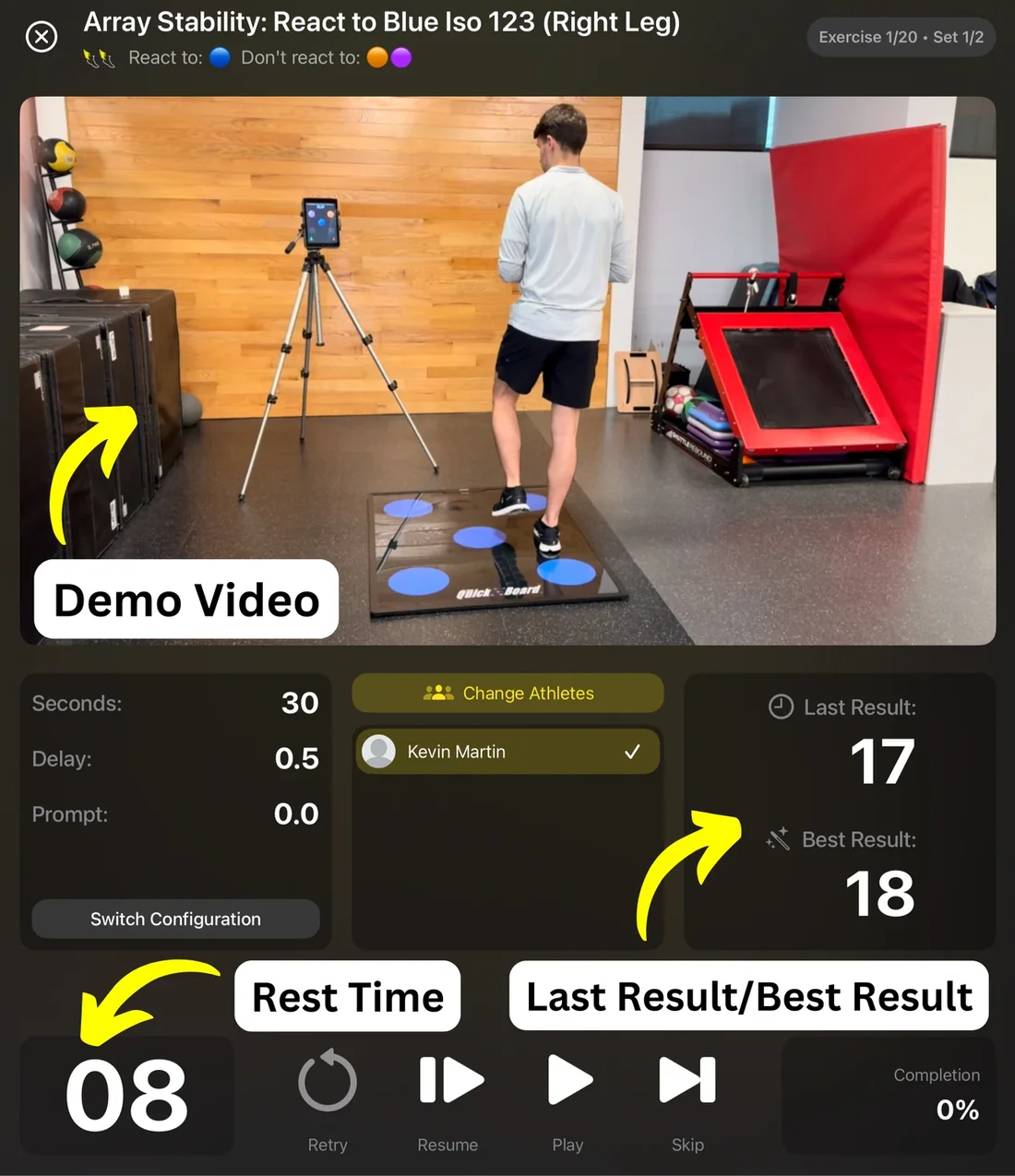
Choose from the pre-built clinical protocol library or load a custom protocol. Patient profile displays Best and Last result prior to every exercise, useful for tracking session-to-session progress in slow-recovering neuro cases.

2
Patient steps onto the board

Patient steps onto the board with whatever supervision the case requires.

3
Data captured automatically

Bilateral symmetry data captures right and left reaction time and ground contact time in milliseconds under cognitive load. Accuracy is calculated from Touches and Errors counted during each exercise. Reactive and dual-task outputs document recovery objectively, session over session.

4
The Progress Report generates

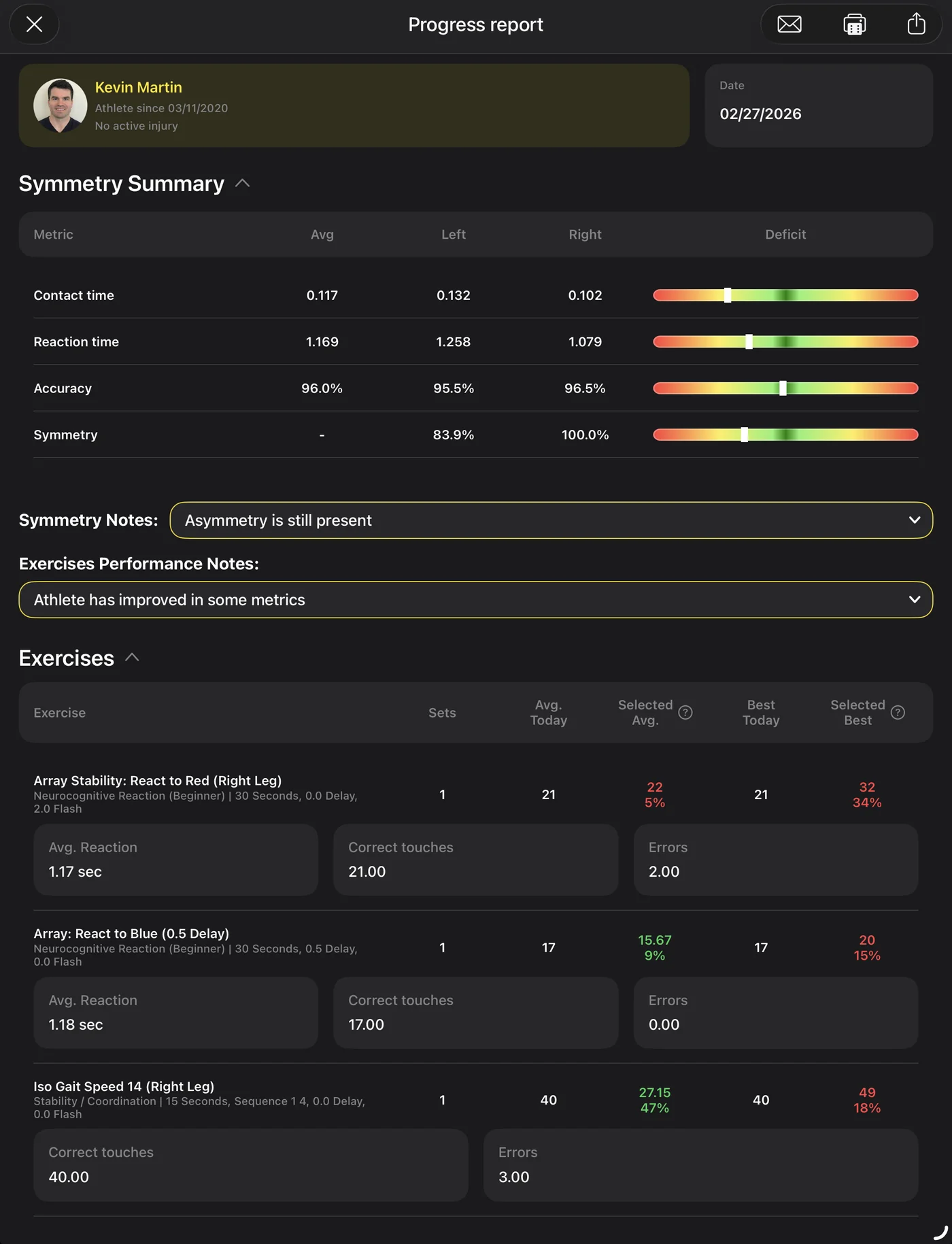
A Progress Report auto-generates as a PDF after every session and is exported to the clinician's email. It carries the right and left reaction time and ground contact time recorded during the session, with a Symmetry Summary showing the percent deficit between the affected and unaffected sides. The clinician forwards, saves, or shares it from there.

QuickBoard app exercise run screen with the demo video, the rest timer between exercises, and the last and best result readouts labeled
The session runs itself: demo video, automatic rest timer, and last and best results on the iPad.
QuickBoard Progress Report showing the Symmetry Summary, clinician notes, and per-exercise results for a session
The Progress Report, auto-generated as a PDF after every session: Symmetry Summary, exercise results, and clinician notes.
Where QuickBoard Is Used

Used in clinical rehab settings.

QuickBoard is in use across rehab clinics, hospital systems, and outpatient neuro programs. The system was designed around clinical PT workflow: portable per-patient deployment, no fixed installation, and protocol automation that lets the clinician stay with the patient.

Setting

Outpatient rehab clinics

Stroke and TBI outpatient programs, vestibular rehab clinics, Parkinson's programs, and fall-prevention groups. The board moves room-to-room and fits any treatment slot.

Setting

Hospital systems

Acute and post-acute rehab units running structured neuro rehab and balance programs. AWS HIPAA best practices, encrypted data, and Enterprise-tier IP whitelisting are available for institutional deployments.

Setting

Geriatric and balance programs

Community fall-prevention programs and senior balance classes. The board has no weight limit, sits flat with no instability surface, and supports gait belt and parallel bar supervision.

FAQ

Common questions for neuro rehab and fall prevention.

Yes, with standard rehab supervision. The board sits flat on the floor with no wobble or instability surface and has no weight limit. Fall-risk patients can train with a gait belt, parallel bars, or with clinician assistance. The clinician sets the protocol; the system rehabs and assesses the patient.

Yes, for physical therapists. CPT 97112 (Neuromuscular Re-education) is the most-used code for neuro sessions on the 8-minute rule. CPT 97530 (Therapeutic Activities) is also available on the 8-minute rule for functional movement protocols.

The Balance Protocol is built for at-risk and neuro populations. The Concussion Rehab Protocol provides progressive cognitive complexity for graded return-to-activity. Custom protocol building is available for clinicians who want to tailor their own. See the research library.

Real falls happen during dual-task moments: walking while talking, reaching while stepping, processing a visual cue while moving. QuickBoard layers a cognitive task (Go/No-Go, Stroop, Discrimination) on top of a standing reactive movement task. The patient processes the visual stimulus on the iPad and steps to the correct sensor location. Reaction time, ground contact time, and accuracy from Touches and Errors are captured under cognitive load, not at rest.

QuickBoard implements Amazon AWS best practices for HIPAA compliance. Data is encrypted in transit and at rest. The Enterprise software tier includes IP whitelisting and usage reports.

HD Sensor Board $2,295. HD Pro $2,495. Both include a lifetime warranty with active subscription. Software subscriptions from $49.99 to $199.99 per month based on profile count. Payment plans up to six months are available for qualifying clinics. See full pricing.

Traditional balance tests measure single-task balance: standing steady, or walking a set distance. Real falls usually happen during dual-task moments, walking while talking or reaching while stepping. QuickBoard adds a cognitive task on top of a standing reactive movement task, so it measures balance under the same kind of cognitive load that causes falls. It also gives objective, millisecond-level reaction data and bilateral symmetry tracking, and it generates a PDF report automatically instead of needing manual documentation.

QuickBoard is used across fall prevention and neuro rehab populations, including stroke, TBI, and Parkinson's disease. For Parkinson's specifically, QuickBoard gives an objective measure of processing speed, which is useful because Parkinson's involves slowed information processing and difficulty with dual-task activities. Training progresses from simple to more complex decisions, the same progressive-complexity model used across other neuro populations.

Motor-learning research backs it up: dual-task practice, moving while processing a cognitive task, improved performance on a completely different, untrained movement (Schaefer & Lang, 2012). QuickBoard layers a Go/No-Go or Stroop task on a stepping response for the same reason: training the processing-under-load skill, not just one drill.

Most falls happen during dual-task moments, walking while talking, not while standing still, and standard balance exercises train single-task standing. QuickBoard trains the gap directly with a cognitive task layered on a stepping response. In an exploratory pilot, stroke patients who trained four weeks this way improved clinical stroke-recovery scores more than a control group with no added program.

15-Minute Virtual Demo

See it before you buy.

A QuickBoard rep walks your team through one or two pre-built protocols, runs an Agility Rating session, and shows the auto-generated reports.

Not ready yet? Read the published research →