For Active Aging Communities

Falls aren't only a strength problem. They're a thinking-while-moving problem.

Standard fitness programming builds strength, cardio, and flexibility. QuickBoard adds the cognitive layer real life demands: reacting to a cue, filtering a distraction, and moving under divided attention, tracked automatically every session.

Used in wellness programming at active aging and independent living communities. A systematic review of 25 studies found a strong, consistent association between lower executive function and elevated fall risk in older adults (Hsu et al., Osteoporosis International, 2012).

QuickBoard is a cognitive-motor training system built for wellness professionals at active aging communities, independent living communities, and CCRCs. The hardware is a portable sensor board with 7 sensors. The software is an iPad app that pairs wirelessly and runs interactive exercises and pre-built workouts, each pairing a physical task with a cognitive demand: decision making, selective attention, cognitive flexibility, or response inhibition. Sessions take two to five minutes per exercise. No prior experience is required, and every exercise includes a demo video so residents see what's expected before stepping on the board.

An older adult training sequenced stepping on the QuickBoard sensor board.
The Problem

Most wellness programming skips the cognitive layer of physical function.

Cardio, resistance training, yoga, and tai chi build cardiovascular health, strength, and flexibility. What they don't train is the brain's ability to execute motor decisions quickly and accurately while attention is divided, the exact condition most real falls happen under.

The gap

Falls are not primarily a strength problem.

The CDC reports that 14 million older adults fall each year, and falls are the leading cause of injury-related death for adults 65 and older. A systematic review of 25 studies found a strong, consistent association between lower executive function and elevated fall risk (Hsu et al., Osteoporosis International, 2012). A study of 670 community-dwelling older adults at high fall risk found that those with cognitive impairment fell at more than 2.5 times the rate of their cognitively healthy counterparts (Li and Harmer, Clinical Interventions in Aging, 2020).

The mechanism

Dual-task ability is the measurable signal underneath fall risk.

Carrying a conversation while walking, navigating an obstacle, shifting attention on stairs: dual-task demand is what the nervous system manages in each moment, and standard fitness programming rarely trains it. Neural processing speed declines with age at roughly 1.3 milliseconds per year (Zhang et al., Communications Psychology, 2026), the same pathway that determines how quickly a resident catches themselves when they trip.

The Evidence

The cognitive-motor pathway is trainable, and the field is already moving this direction.

Population matching: these citations apply to community-dwelling older adult and active aging audiences, not athletic populations.

Flagship evidence

Same brain games, different delivery. Only the stepping version cut falls.

In a 769-person randomized trial published in Nature Medicine, community-dwelling adults 65 and older trained at home for a year on a custom computerized step mat, with cognitive games driving the stepping (Sturnieks et al., 2024). A second group played the identical games seated, responding by hand on a touch pad. Only the stepping group cut its rate of falls: 26 percent fewer falls than control. The seated group did not significantly reduce falls. The stepping was the difference.

The trial used a custom research step mat, not QuickBoard, so it stands as evidence for the training category. Its population, healthy, independent, community-dwelling older adults, is precisely the population active aging communities serve. And the year of unsupervised home training produced no serious training-related adverse events.

Mechanism 1

Dual-task capacity

Falls happen when attention is divided. Training that makes a resident think and move at the same time rehearses exactly that condition. The Nature Medicine trial is the cleanest demonstration: identical cognitive games in both groups, and only the group that had to step while thinking reduced falls.

Mechanism 2

Rapid force and the fast-twitch decline

Aging shrinks type II fibers, the fast-twitch fibers that produce force quickly, more than anything else (Nilwik et al., Experimental Gerontology, 2013), and muscle power predicts functional limitation better than strength (Reid and Fielding, 2012). A recovery step after a stumble is a maximal-speed force event, and reactive stepping to unpredictable targets trains exactly that output. QuickBoard training is designed around the mechanisms these studies describe.

Sturnieks et al. · Nature Medicine · 2024 · Randomized controlled trial

Home-based exergame step training vs. identical seated cognitive training. 769 community-dwelling adults 65 and older, 12 months.

Found step training cut the rate of falls by 26 percent versus control. The identical games played seated did not significantly reduce falls. Category evidence for step-based cognitive-motor training on a custom research step mat.

Okubo, Schoene and Lord · British Journal of Sports Medicine · 2017 · Meta-analysis

Step training and falls in older people. Systematic review and meta-analysis of the step-training literature.

Found reactive and volitional step training roughly halved the rate of falls in older people, and improved stepping reaction time, single-leg stance, and Timed Up and Go performance.

Lord and Fitzpatrick · Journals of Gerontology Series A · 2001 · Prospective cohort

Choice stepping reaction time as a falls predictor. 477 older adults.

Found that slower choice stepping reaction time, how fast a person steps onto a lit panel, independently predicted future falls, outperforming individual measures of strength, speed, and balance.

Khan et al. · European Geriatric Medicine · 2025 · Meta-analysis

Dual-task exercise training in community-dwelling older adults. 44 randomized controlled trials, 2,782 participants.

Found dual-task exercise training significantly improves dynamic balance, functional mobility, and fall frequency. Meta-regression tied the strongest dynamic balance and functional mobility gains to three sessions per week.

Gao and Liu · Geriatric Nursing · 2025 · Systematic review

Cognitive-motor dual-task training vs. traditional fall-prevention programs. Community-dwelling older adults.

Found that cognitive-motor dual-task training outperforms traditional fall-prevention programs on gait, dynamic balance (at 12 weeks or more), and executive function.

Zhang et al. · Communications Psychology · 2026 · Harmonized reaching-task analysis

Age, sex/gender, and experience effects on motor control. 2,390 participants across four reaching studies.

Found neural processing speed declines with age at roughly 1.3 milliseconds per year, the reaction-time signal underneath dual-task deficit.

Hardwick et al. · Journal of Neurophysiology · 2022

Age-related slowing in movement preparation. Mechanism research.

Found that age-related reaction-time slowing reflects slower movement preparation, not increased hesitancy to respond.

Hsu et al. · Osteoporosis International · 2012 · Systematic review

Executive function and fall risk in older adults. 25 studies.

Found a strong, consistent association between lower executive function and elevated fall risk in older adults.

Li and Harmer · Clinical Interventions in Aging · 2020

Cognitive impairment and fall rate in high fall-risk older adults. 670 community-dwelling older adults.

Found participants with cognitive impairment fell at more than 2.5 times the rate of cognitively healthy peers, with significantly higher dual-task walking costs.

Where QuickBoard Fits

Suitable across the continuum of physical function.

For your most active residents

QuickBoard provides a challenge beyond standard cardio and resistance programming. Reaction, discrimination, and Stroop exercises require fast cognitive processing under physical demand, so residents who've plateaued on traditional fitness metrics keep making measurable progress.

For residents rebuilding balance and confidence

This is QuickBoard's most relevant fit: residents with adequate standing balance who need to rebuild cognitive engagement with movement, or who are beginning to show signs of dual-task deficit. The board's sensor feedback keeps the resident focused on the screen rather than on their feet, an external-focus approach. In older adults, the research is clearest on the downside of the opposite cue: telling someone to watch their own feet makes gait less stable.

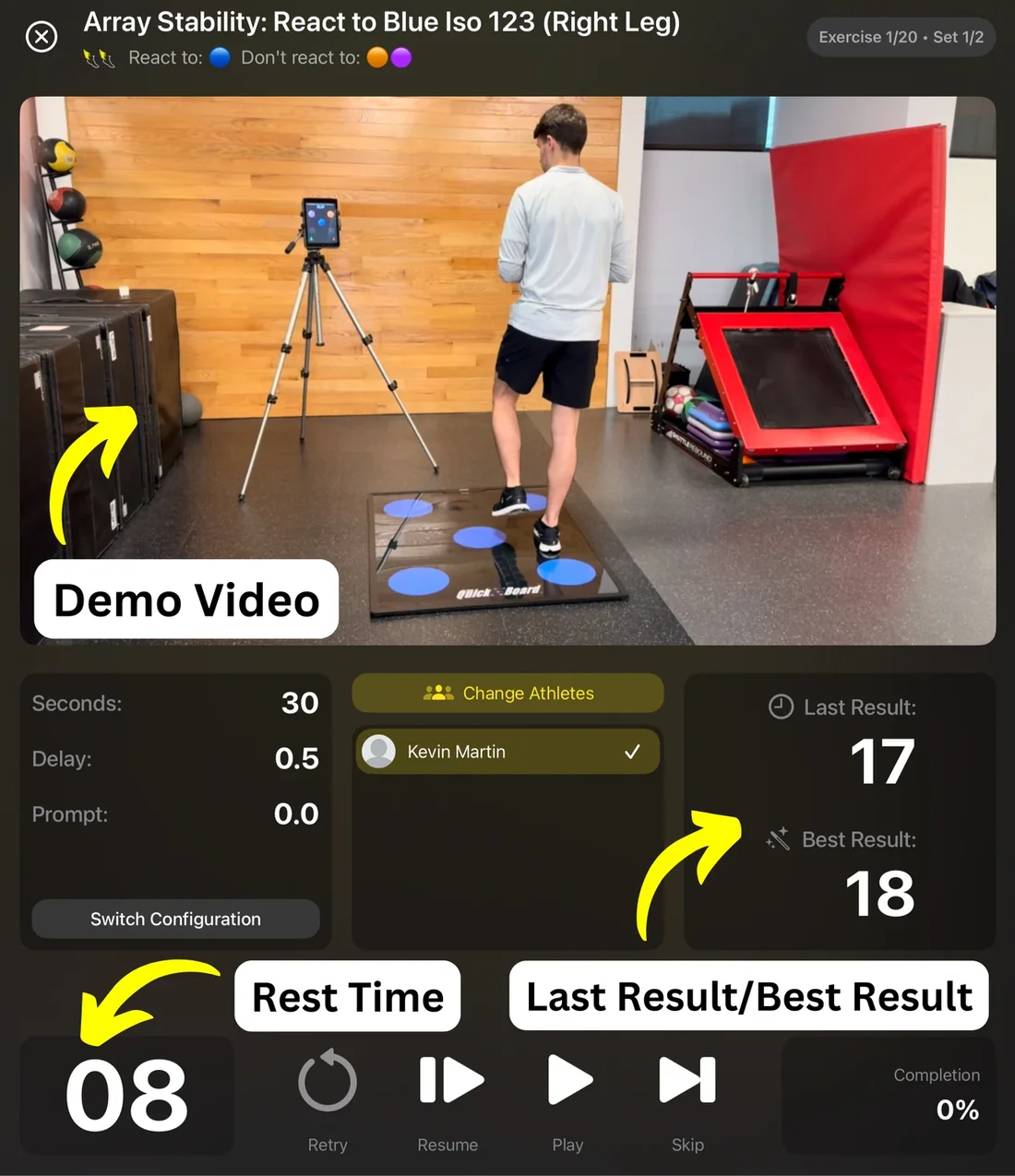
Multiple residents use the same board under individual profiles, with progress tracked separately for each. Automation mode runs a full workout without staff input, so a session can be started and then managed from a distance.

QuickBoard app exercise run screen with the demo video, the rest timer between exercises, and the last and best result readouts labeled
The session runs itself: demo video, automatic rest timer, and last and best results on the iPad.
Exercise Types

Reactive exercises built for wellness programming.

Reaction

Reaction

A target appears on the iPad and the resident steps on the corresponding sensor as quickly as possible. Trains the processing speed behind protective stepping, the response that catches a trip before it becomes a fall.

Discrimination

Discrimination

Multiple cues appear at once. The resident responds to the designated cue and filters out the others, training the selective attention and decision speed that decline with age.

Go/No-Go

Go/No-Go

The iPad presents a stream of cues. The resident responds to "go" cues and holds back on "no-go" cues, training the response inhibition most closely linked to fall risk in the research literature.

Stroop

Stroop

The resident reacts based on the relationship between a color cue and a letter cue while physically moving on the board, a dual-task structure matching the training model shown to improve balance and functional mobility.

Balance

Balance

Sensor-feedback single-leg or bilateral stability exercises under a timed hold, pairing naturally with reaction and discrimination exercises in a single session.

Workouts

Workouts

Pre-built multi-exercise sequences grouped by training focus, Speed, Stability, Movement, and Reaction, at three difficulty levels. In automation mode, residents move through a full workout hands-free.

What You Can Measure

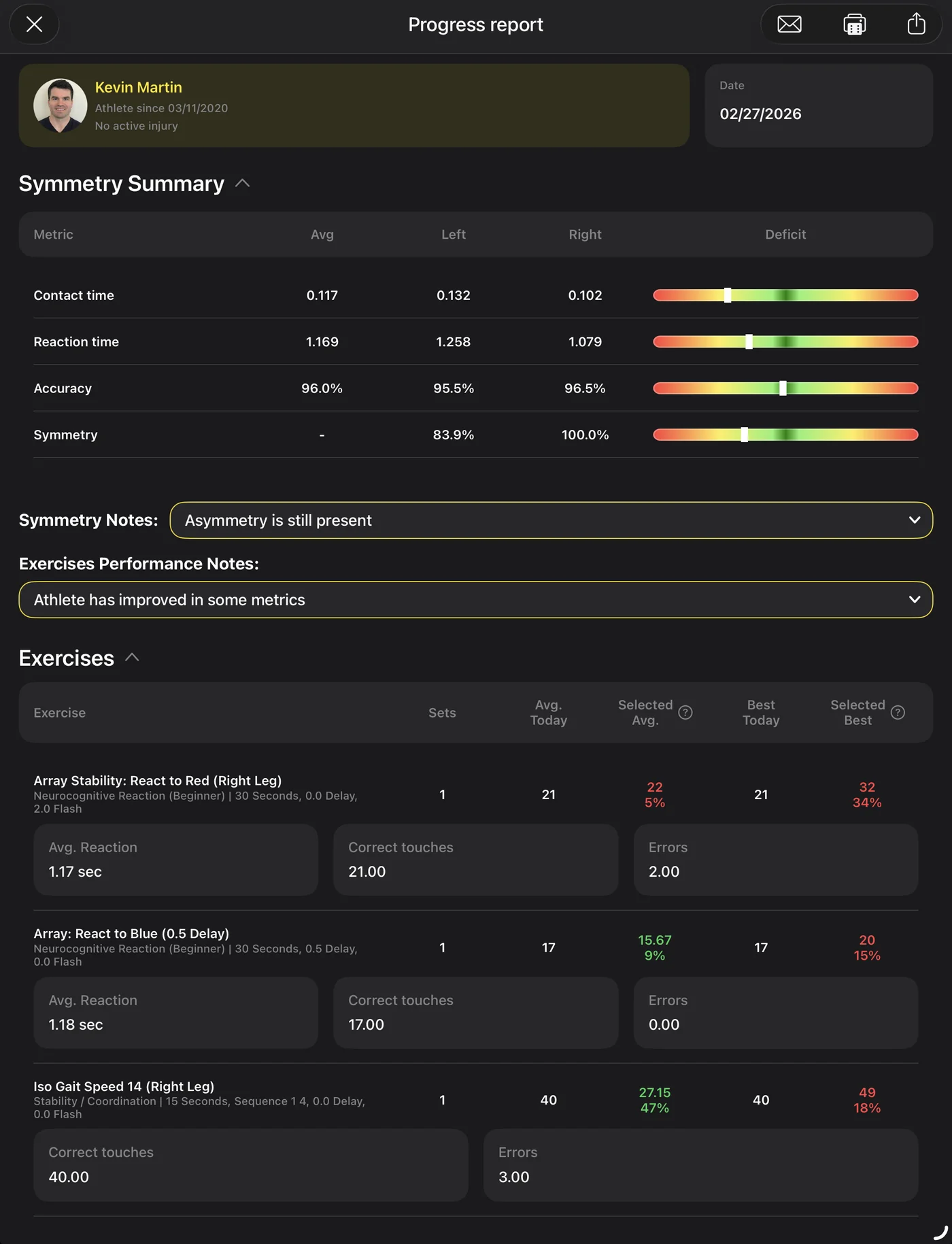
A Progress Report after every session, no manual entry.

  • Reaction time per exercise, per side, and session average, tracked over time.
  • Accuracy, the percentage of correct responses on Discrimination and Go/No-Go exercises.
  • Ground contact time, used for bilateral symmetry analysis.
  • Bilateral symmetry across reaction time, accuracy, and ground contact time.
  • Exercise summary breaking down each exercise completed in the session.
QuickBoard Progress Report showing the Symmetry Summary and per-exercise results for a session

The Agility Rating Report provides a composite performance score across speed, accuracy, and agility metrics, letting wellness professionals benchmark residents over time. Reports export as PDFs that can be shared with residents or included in wellness documentation, giving wellness directors the outcome data to demonstrate programming effectiveness without manual tracking.

Beyond Physical Fitness

Fits into a whole-person wellness program.

QuickBoard primarily strengthens physical and cognitive function, with effects that reach into how residents feel and engage day to day.

Physical

Direct training of motor function, reaction speed, balance, and bilateral symmetry across the continuum of physical function.

Intellectual / Cognitive

Every exercise carries a cognitive demand. Discrimination, Go/No-Go, and Stroop train attention control, response inhibition, and cognitive flexibility through movement, not alongside it.

Emotional

Visible, measurable progress supports resident confidence and sustains participation over time.

Social

Individual profiles on a shared board support performance comparison, competitive formats, and leaderboard structures in group fitness settings.

Programming Models

Three ways communities integrate QuickBoard.

Standalone Session

Standalone Cognitive-Motor Session

15-20 minutes. One or two residents use the board during a scheduled session. Wellness staff sets up the board and monitors from a distance while residents complete a pre-built workout in automation mode. Works in any community with a wellness room or fitness center.

Circuit Station

Circuit Station in Group Fitness

QuickBoard operates as one station in a group fitness circuit. While other residents rotate through strength or balance stations, individuals spend 5-8 minutes on QuickBoard. Staff manages the circuit; the board runs autonomously within its station.

Supervised Protocol

Supervised Dual-Task Protocol

For residents who need the most support rebuilding balance and movement confidence, QuickBoard serves as the primary intervention in a supervised session. The wellness professional monitors movement quality while the board delivers the cognitive-motor protocol.

The Business Case

Wellness programming affects occupancy and length of stay.

Industry research on wellness programming, drawn from nearly 100 senior living communities, found that wellness participants in independent living tend to stay in their communities approximately two years longer than non-participants (Wellness Benchmarks National Report).

Communities competing for a generation of older adults with high expectations for programming need offerings that go beyond the standard fitness center. QuickBoard adds a documented, evidence-based programming layer most communities don't yet offer. It produces resident-level outcome data and runs with minimal staff time per session.

Pricing is structured for the independent living and active adult context. Monthly subscription includes the full exercise library, protocol library, and all reporting features. Hardware carries a lifetime warranty with an active subscription.

FAQ

Common questions for wellness programming.

Yes, with standard wellness-staff supervision. The board sits flat on the floor with no wobble or instability surface and has no weight limit. Residents can train with staff nearby, alongside parallel bars, or with a chair for support.

It means pairing a physical task, stepping on the board's sensors, with a cognitive demand: reacting to a cue, filtering a distraction, or making a fast decision. This dual-task structure is the mechanism the research links to fall risk reduction, not physical training alone.

Residents across the continuum of physical function, from highly active residents looking for a new challenge to those working to maintain functional independence. It's most directly applicable for residents with adequate standing balance who are beginning to show signs of dual-task deficit.

Not necessarily. Automation mode runs a full pre-built workout hands-free, with demo videos so residents know what to do before stepping on the board. Staff can set up a session and monitor from a distance, or run it as a directly supervised protocol.

Every session generates a Progress Report automatically: reaction time, accuracy, ground contact time, and bilateral symmetry, plus a composite Agility Rating score. Reports export as PDFs for resident sharing or wellness documentation, with no manual data entry.

Pricing is structured for the independent living and active adult context, with a monthly subscription covering the full exercise library, protocol library, and reporting features, and a lifetime hardware warranty with an active subscription. See full pricing.

Free Guide

Cognitive-Motor Readiness: a guide for wellness professionals.

Why fall risk isn't only a strength problem, the research on cognitive-motor and dual-task training, and where QuickBoard fits across the continuum of physical function. Free download, no demo required.

Virtual Demo

See it before you bring it to your community.

A QuickBoard rep walks your team through the system, runs an Agility Rating session, and shows the auto-generated reports. No obligation.

Not ready yet? Read the published research →