
Used in ortho rehab clinics, sports medicine programs, and hospital-based PT settings

Cleared to return. Not cleared to react.

Standard RTS testing clears physical readiness, not split-second reaction under cognitive load. QuickBoard tests and trains that gap, and documents it for CPT billing, with pre-built ACL protocols you don't have to design.

In plain language

QuickBoard for ACL and return-to-sport, at a glance.

QuickBoard adds a reactive test and a training layer to an ACL return-to-sport program. The patient stands on a sensor board at full body weight and reacts to targets on an iPad screen. Every rep records reaction time, ground contact time, and symmetry for each leg. The report, with billing documentation, writes itself.

What it measuresReaction time under cognitive load, per-leg ground contact time, accuracy, and left-right symmetry. The Agility Rating combines them into one 0 to 10,000 score in under two minutes.
Where it fitsAlongside strength, hop, and force plate testing, not instead of them. It adds the reactive layer those tests do not measure. It is not a clearance decision on its own.
EvidenceChmielewski et al. (IJSPT 2024) is independent research by TRIA Orthopedic Center that used QuickBoard as the reaction test. ACL patients who met the 90% hop symmetry standard did not score better on the reaction tests. QuickBoard is recommended technology for neurocognitive and neuromuscular rehabilitation.
ProtocolsPre-built ACL protocols are included. You run them, you do not design them. The session runs itself while you treat another patient.
BillingCPT 97750 for the Agility Rating, and 97530 or 97112 for protocol sessions. Reimbursement varies by payer.
Cost$2,295 (HD Sensor Board) or $2,495 (HD Pro), one time. Software runs $49.99 to $199.99 per month.
First patientThe board ships within 10 to 14 business days. Setup takes about 15 minutes or less, and the first patient can train on day one.

Force plate, strength, and hop tests aren't measuring the same thing.

Both matter. Many programs add QuickBoard to their existing protocol, not instead of it.

What standard RTS tests measure
  • ■Strength and quad torque output
  • ■Limb symmetry index
  • ■Hop distance
  • ■Functional performance under self-paced conditions

These tests measure what the body produces on demand, with full attention, in a quiet room.

What QuickBoard tests
  • ■Reaction time under cognitive load
  • ■Bilateral decision-making speed
  • ■Reactive accuracy
  • ■Symmetry under unanticipated reactive demands

These tests measure how the nervous system controls movement when the athlete can't fully predict what comes next.

Agility Rating

One repeatable score for tracking rehab progress and supporting return-to-sport decisions.

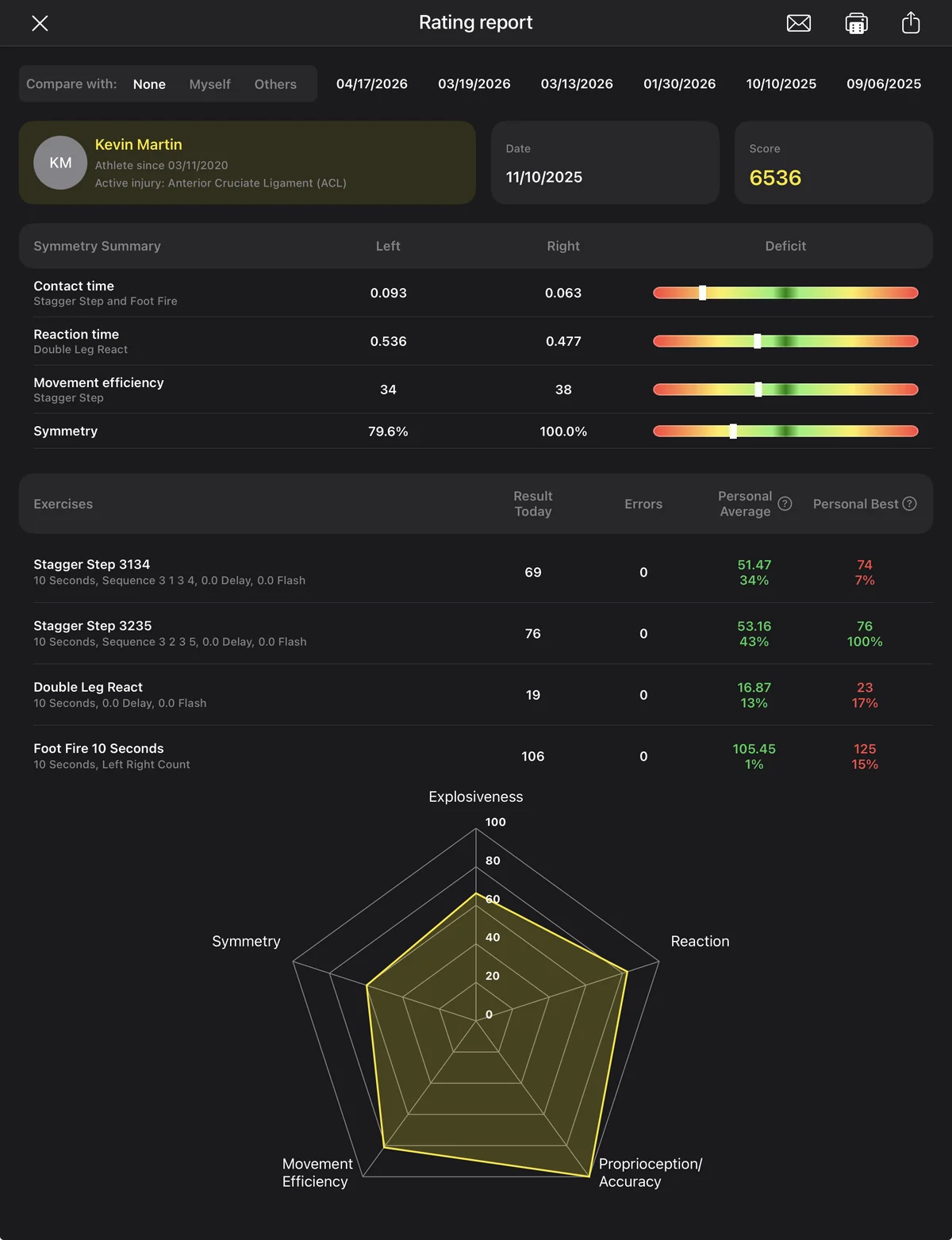
A composite score from 0 to 10,000, built from four scored exercises on the sensor board. The assessment runs in under two minutes and auto-generates a PDF report. Re-test at any point in the plan of care to show change over time.

Tracking rehab progress

Baseline early, then re-test on your own schedule. The score breaks into five dimensions, so you see which one is moving. Not just a single number with no explanation. The Symmetry Summary compares left and right and names the deficit side.

One caution on reading symmetry: the better-performing side is labeled 100%. That means better, not recovered. Both sides can still be below where the patient needs to be.

The QuickBoard Agility Rating Report showing the composite score, symmetry summary, exercise results, and radar chart
The Agility Rating Report, generated after every assessment.
Supporting return-to-sport decisions

The Agility Rating adds the reactive layer to an existing RTS battery. It does not replace strength, hop, or force plate testing, and it is not a clearance decision on its own.

It shows what a self-paced battery cannot: how the patient reacts, decides, and holds symmetry under unpredictable demand. The weakest dimension also drives which protocol the app recommends next.

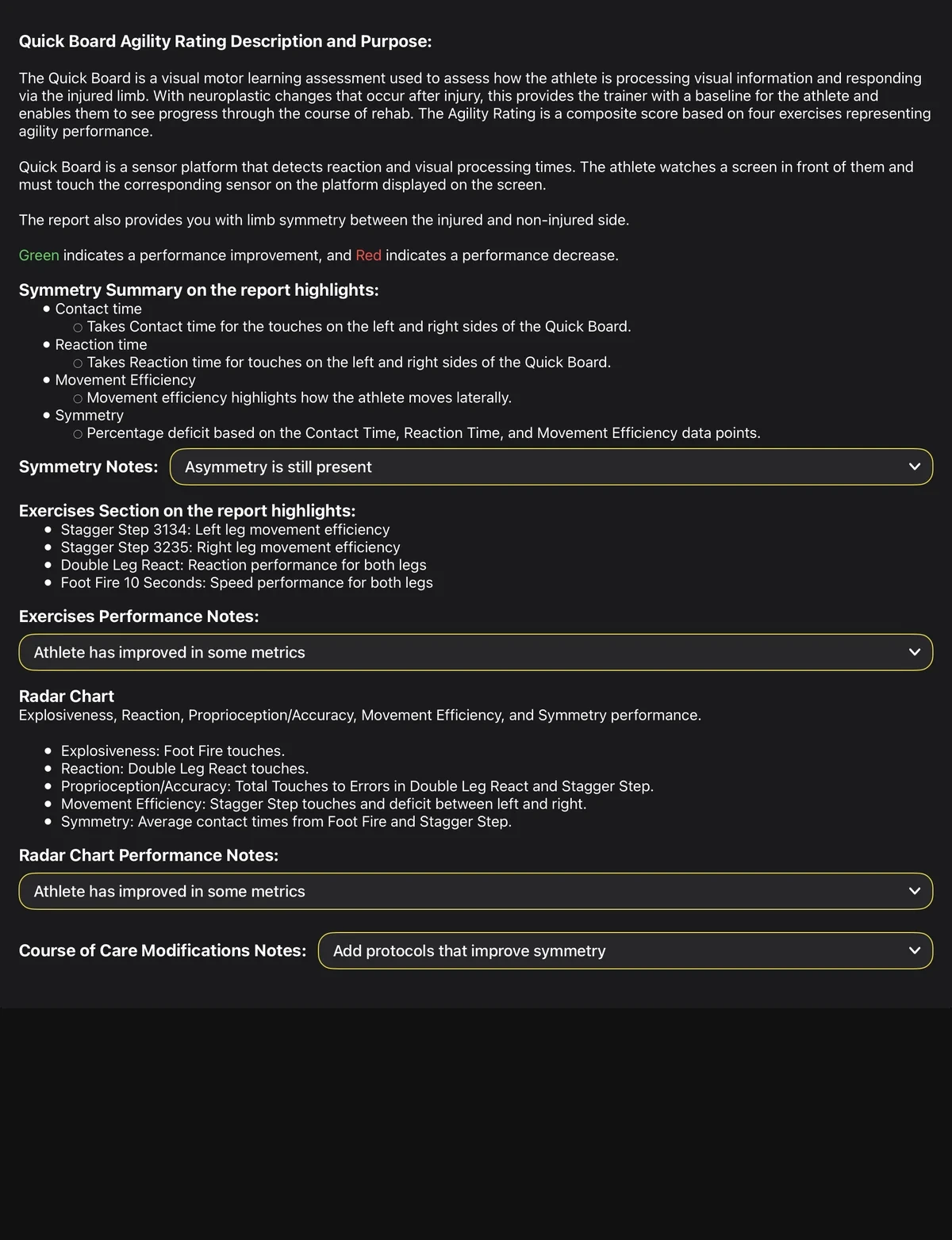
The CPT 97750 Description and Purpose page of the Agility Rating Report, with pre-filled clinical documentation
The CPT 97750 Description and Purpose, pre-filled for billing.

What the report says to each audience.

Every assessment produces the same PDF. Its second page carries the Description and Purpose text, so one report serves three readers.

For patients

Progress they can actually see.

Recovery is hard to feel week to week. A score and a five-dimension chart give the patient something concrete to compare against their last visit. The symmetry bar shows which side needs the work.

For referring surgeons

A standardized report that travels.

The PDF generates after each assessment and exports to email. The format does not change between visits, so a referring physician can line up two reports and read the difference. Clinics using it tell us some orthopedic referrers began asking for it by name.

For payers

Documentation written before you ask.

The Agility Rating is billable under CPT 97750 in 15-minute increments, and not on eval or re-eval days. The report arrives with the Description and Purpose text 97750 requires, plus pre-filled performance dropdowns. The chart note can reference the attachment.

Billing time must include setup and report review with the patient to meet the minimum for 97750. Confirm coding with your payer and a qualified billing professional.

Billing

Three CPT codes. Documentation pre-populated.

A Progress Report PDF generates automatically after every treatment session. An Agility Rating Report generates after every assessment, with CPT 97750 description and purpose pre-filled.

CPT 97750

Physical Performance Test

Agility Rating assessment. Billed in 15-minute increments. Not billable on eval or re-eval days. Auto-generated PDF includes Description and Purpose pre-filled.

CPT 97530

Therapeutic Activities

Functional protocol sessions. Billed on the 8-minute rule. Use when the protocol centers on functional movement tasks.

CPT 97112

Neuromuscular Re-education

Neuro rehab protocol sessions. Billed on the 8-minute rule. For populations where neuromuscular re-education is the documented goal.

Reimbursement and same-visit billing

How much will Medicare pay me for 97750?

It depends on where you practice and who the payer is. Medicare sets a national amount for each code every year, then adjusts it for your locality. Look up your exact rate in the CMS Physician Fee Schedule Look-Up Tool. Commercial and Medicaid rates follow your own contracts, and coverage varies by payer. QuickBoard does not set or promise any payment amount.

Can I bill 97530 and 97112 on the same visit?

Often, yes, when each code covers its own block of time and its own goal. Both are timed codes, so document the minutes and the purpose of each one separately. For Medicare, your total timed minutes set the total units billed (the 8-minute rule). Some payers apply National Correct Coding Initiative (NCCI) edits to certain code pairs. When an edit applies, a modifier such as 59 or XS shows the services were distinct. Check the current CMS NCCI edit tables and your payer's policy.

Can I bill 97750 in the same visit as 97530 or 97112?

Many clinics assess with 97750, then treat with 97530 or 97112 in the same treatment visit. Each service needs its own documented time and its own medical necessity. The same minutes cannot count toward two codes. 97750 is not billed on eval or re-eval days. Payer rules decide same-day billing and whether a modifier is required.

Coverage and coding rules vary by payer. Confirm with your payer and a qualified billing professional.

Where many cognitive assessment tools map to a single CPT code, QuickBoard maps to three.

Confirm coding with your payer and a qualified billing professional.

Run your numbers in the revenue calculator

For codes, documentation, and denials, see the free CPT billing guide for PT clinics.

For PT Clinic Owners

Assessment, protocol, documentation. In that order, every visit.

Where the Multi-Athlete Workflow below spans a season, this is the per-visit loop your clinic runs every day.

1

Assessment

Run the Agility Rating at the start of the visit. Under two minutes. The PDF report generates automatically, with CPT 97750 documentation pre-populated.

2

Protocol

Prescribe one of the pre-built cognitive-motor protocols. The system runs the session. The clinician documents, treats, and moves to the next patient.

3

Progress

Export the PDF report. Attach it to the patient record. CPT 97750 documentation is already in the file.

Dual-Task Training

Sport is never single-task. Most RTS batteries are.

QuickBoard Companion syncs up to three additional iPads or iPhones to the sensor board session, each running one or more reaction stimuli.

Reaction exercises

Feet react on the board while hands react on the synced devices, at the same time.

Speed-focused exercises

Feet drive the board while hands react to stimuli on the companions.

Fully automated

The protocol runs on its own, so the clinician is free to work with other patients while it runs.

One unified report

Companion reaction times save alongside the sensor board results, no separate system to reconcile.

That is what makes evidence-based dual-task training practical here. Done by hand, it is labor-intensive and the scoring is subjective.

Companion running an upper-extremity reaction task while the lower body trains on the sensor board.

A growing body of RTS research argues standard testing misses this. Hop tests, strength symmetry, and limb-symmetry batteries are single-task: the athlete's full attention is on the movement. Real injuries rarely happen that way. Grooms et al. (JOSPT, 2023) recommend adding a cognitive task to hop testing. Dual-task performance can flag reinjury risk that single-task tests miss. Chaaban et al. (2023) make the same case. Most ACL injuries happen while an athlete is thinking and moving at once. RTS testing should measure the same thing.

Score your RTS battery in seven questions

Evidence

Passing physical clearance is not the same as being ready to react.

Four ACL and post-reconstruction sources make the case: hop and reaction results do not move together, and leading clinical guidance recommends QuickBoard to train the layer standard protocols miss. All citations below are ACL population only, with framing notes for each.

Chmielewski et al. · IJSPT · 2024 · ACL/athletic population

Advanced neuromuscular training differentially changes performance on visuomotor reaction tests and single-leg hop tests in patients with ACL reconstruction. International Journal of Sports Physical Therapy.

Independent research by TRIA Orthopedic Center, the University of Minnesota, and Mayo Clinic, with QuickBoard as the reaction test. After a five-week return-to-sport program, hop scores improved more than QuickBoard reaction scores. Patients who met the 90% hop symmetry standard did not score better on the reaction tests. Physical clearance and cognitive-motor readiness are not the same endpoint.

Clinical commentary · IJSPT · 2024 · ACL rehabilitation population

Neurocognitive and Neuromuscular Rehabilitation Techniques after ACL Injury. International Journal of Sports Physical Therapy.

Leading clinical guidance on neurocognitive and neuromuscular rehabilitation that recommends QuickBoard as a cognitive-motor assessment and training tool. Framing: this is a commentary, not an RCT. Full citation on the research page.

Grooms et al. · JOSPT · 2017 · ACL reconstruction population

Neuroplasticity Associated With ACL Reconstruction. Journal of Orthopaedic and Sports Physical Therapy.

ACL injury reorganizes brain activation patterns. The reconstructed knee shifts to visual and cortical control. Reactive deficits can persist after physical clearance because the underlying neurological change persists.

Wellsandt et al. · JOSPT · 2017 · ACL reconstruction population

Limb Symmetry Indexes Can Overestimate Knee Function After ACL Injury. Journal of Orthopaedic and Sports Physical Therapy.

57% of patients passed the 90% limb-symmetry threshold, but only 29% had truly returned to their own pre-injury capacity. Symmetry overstates recovery because the uninjured limb weakens after surgery too. Physical symmetry is a threshold, not full readiness. The study's own reported result: “57.1% cleared 90% LSI; only 28.6% met 90% estimated pre-injury capacity (EPIC).”

Clinician Voice

What PTs say about using QuickBoard in the clinic.

"

The Quick Board is a game-changer for us. By tracking baseline data, we know if an athlete is trending in the right direction AND if they need more attention in certain areas. We use this for concussion, knee, ankle, hip, core, and shoulder rehab. One of the best pieces of technology to assist in quantifying return to play readiness.

Dr. Andrea Davis
Dr. Andrea Davis, DPT
PT, MS, DPT
"

I have been using the Quick Board for a couple of years now and have not only seen great results, but I have seen patient/athlete cooperation and compliance increase dramatically. Our clinic applies Quick Board for stability and return to function, including returning to weight-bearing symmetry. The Quick Board allows patients to perform and re-educate the nervous system while providing feedback with scores and errors. Overall, the Quick Board makes training athletes and rehabbing patients exciting, competitive, and fun.

Dr. Chad Molen
Dr. Chad Molen, DPT, SCS, CSCS
DPT, SCS, CSCS, LMT
FAQ

Common ortho rehab questions.

Not on its own. In independent research from TRIA Orthopedic Center, QuickBoard was the reaction test for ACL patients. Patients who met the hop symmetry standard did not score better on the reaction tests (Chmielewski et al., IJSPT 2024). Hop and reaction results did not move together. Physical readiness and reactive readiness are separate clinical questions, so test both.

Return-to-sport researchers increasingly say yes. Hop tests and strength tests are single-task, with full attention on the movement. Real injuries rarely happen that way. Grooms et al. (JOSPT, 2023) recommend adding a cognitive task to hop testing, and Chaaban et al. (2023) make the same case. QuickBoard adds that layer by testing decision speed and footwork together, next to the battery you already run.

QuickBoard is recommended technology for neurocognitive and neuromuscular rehabilitation. It appears in leading clinical guidance on neurocognitive and neuromuscular rehabilitation as a cognitive-motor assessment and training tool. The full peer-reviewed citation lives on the research page.

Not in the one study that measured both with QuickBoard. After a five-week return-to-sport training program, ACL patients gained less on QuickBoard reaction tests than on hop tests (Chmielewski et al., IJSPT 2024). Reaction scores did improve, just by less. The research was independent, from TRIA Orthopedic Center, and QuickBoard was the test, not the training. The authors call for more dual-task challenges in ACL rehab.

Pre-season: baseline every athlete in minutes with the Agility Rating. In-season: re-test on demand to flag reaction-time drops and intervene early. Return-to-play: add the reactive layer to your existing RTS protocol. The board runs automated sessions with real-time feedback, and reports generate as PDFs without manual data entry.

Three codes: CPT 97750 (Physical Performance Test) for the Agility Rating assessment in 15-minute increments, not on eval or re-eval days. CPT 97530 (Therapeutic Activities) for functional protocol sessions. CPT 97112 (Neuromuscular Re-education) for neuro rehab protocols. The Agility Rating Report PDF auto-generates after each session with CPT 97750 Description and Purpose pre-populated.

No. Strength, hop, and force plate tests measure what the body produces on demand, with full attention. QuickBoard adds the reactive layer. It measures reaction time, per-leg contact time, and symmetry against cues the patient cannot predict. Many clinics run QuickBoard alongside their existing battery. The Agility Rating supports a return-to-sport decision, but it is not a clearance decision on its own.

It depends on where you practice and who the payer is. Medicare sets a national amount for each code every year, then adjusts it for your locality. Look up your exact rate in the CMS Physician Fee Schedule Look-Up Tool. Commercial and Medicaid rates follow your own contracts, and coverage varies by payer. QuickBoard does not set or promise any payment amount.

Often, yes, when each code covers its own block of time and its own goal. Both are timed codes, so document the minutes and the purpose of each one separately. For Medicare, your total timed minutes set the total units billed (the 8-minute rule). Some payers apply National Correct Coding Initiative (NCCI) edits to certain code pairs. When an edit applies, a modifier such as 59 or XS shows the services were distinct. Check the current CMS NCCI edit tables and your payer's policy, and confirm with a qualified billing professional.

The Agility Rating is a composite score from 0 to 10,000 generated by QuickBoard. It measures five dimensions: Explosiveness, Reaction, Accuracy, Movement Efficiency, and Symmetry. The assessment runs in under two minutes and auto-generates a PDF report with a five-dimension radar chart and Symmetry Summary. It is billable under CPT 97750.

Reaction lights are useful, portable tools for reaction drills, and some market to rehab settings. QuickBoard is built for clinical rehab specifically. The patient stands on the sensor board at full body weight, so every rep captures bilateral symmetry, contact time, and reaction time on each leg. It also runs full cognitive protocols including Stroop, and it auto-fills CPT 97750 documentation into an exportable clinical PDF. QuickBoard is also used in published, standardized rehab research, and it is recommended technology for neurocognitive and neuromuscular rehabilitation. Reaction lights do not currently have that level of standardized rehab research behind them. See QuickBoard next to reaction lights for the full side-by-side.

The HD Sensor Board is $2,295, or $2,495 for the larger HD Pro, both with a lifetime warranty on an active subscription. Software starts at $49.99 a month for 25 profiles. The Agility Rating assessment bills under CPT 97750, and sessions can also bill under CPT 97530 or CPT 97112 depending on the protocol. For clinics already delivering these services, QuickBoard automates protocol delivery and documentation that would otherwise take staff time. Payment plans up to six months are available for qualifying clinics.

15-Minute Virtual Demo

See the reactive layer your RTS protocol is missing.

A QuickBoard rep walks your team through the clinical workflow, runs an Agility Rating session, and shows the auto-generated reports. 15 minutes.

Setup takes one session. Your team runs protocols the same day, and your billing team gets documentation from day one, no extra training needed.

Read the published research →