
Eyes up at a screen, or eyes down at the floor. The training effect is not the same.
Floor pods pull the athlete's gaze to the ground. QuickBoard keeps the eyes up on the screen while the feet react under full body weight. That difference is external focus, and across many studies it has outperformed attention on the body itself. Many facilities and clinics use both tools as part of a complete reactive setup.
Same category of drill. Different training effect.
Four differences change what the athlete's nervous system actually practices.
The gaze goes where the stimulus is.
Floor pods put the stimulus at the athlete's feet, so the head drops and the eyes track the ground. QuickBoard puts the stimulus and real-time feedback on the screen at eye level, so attention stays on an outside target while the feet work. Across many studies, attention on an outside target has produced better performance than attention on the body (Wulf, 2013). College athletes cutting under an external focus cue posted faster change-of-direction and acceleration times than under an internal or neutral cue (McNicholas and Comyns, JSCR 2020). Sport is played eyes up. Train it that way.
A reactive step, not a toe tap.
Deactivating a pod takes a touch. It can be done with a hand, or a toe, with no weight transfer at all. On QuickBoard the athlete stands on the board, so every reaction is a step that loads the limb under full body weight. That is the more ecological demand: the movement that catches a cut, a landing, or a stumble is a loaded step, not a tap.
Cognitive interference, not just discrimination.
Modern pods run color and symbol discrimination and Go/No-Go style logic, and that is a real cognitive layer. QuickBoard also runs Stroop protocols, where the stimulus and the correct answer conflict and the athlete has to suppress the automatic response mid-movement. Reversible-rule Stroop variants train response inhibition and cognitive flexibility together.
Hands on one task, feet on another, eyes always up.
The free QuickBoard Companion app pairs a second screen into any exercise type. The athlete scans up, reacts with the hands to the Companion, and reacts with the feet to the board, at the same time, never looking at the ground. That is two simultaneous task streams, a true dual-task, not one stimulus stream answered with one response.
Reaction lights are good at what they were built for.
Portable reaction lights deliver simple visual reaction drills wherever the pods are placed. They are engaging and easy to set up. They travel well, the spacing is flexible, and they keep athletes moving.
They do the same job in training and in rehab, and they work at every stage of a rehab rather than only the end of one. Seated foot taps put a reactive cue in front of a patient with no weight through the limb. Hand reactions run alongside a lower-limb exercise. The same pods move to the floor for standing agility work later. For reaction drills, they work. The two tools do different jobs.
Reaction lights build the drill. QuickBoard builds the record.
They answer different questions.
Neither replaces the other. They measure different things.
Can this athlete hit the light that lit up?
- Simple visual stimulus and response
- Hit count and basic reaction-time logs
- Portable, flexible spacing, seated or standing
- Reactive work at any stage, in the clinic or on the field
The athlete looks at the target and taps or deactivates the pod, with a hand or a foot.
Can this athlete react, decide, and stay symmetric under load?
- Ground-target foot reactions under full body weight
- Decision speed under cognitive load
- Bilateral symmetry, left leg versus right
- Automated scoring and a clinical PDF report
The athlete reacts with the feet to targets on the board, eyes on the screen.
Neither replaces the other. They measure different categories of readiness.
A pod session rarely leaves behind a left-versus-right score.
A hit count tells you the athlete was fast. It does not tell you which leg carried the load.
Reaction under full body weight
The athlete reacts by moving the feet to targets on the board, loading each leg under full body weight. That weight-bearing reaction is what makes left-versus-right symmetry measurable. Reactive movement quality, scored.
Choice reaction, not just "hit the light"
Go/No-Go, Discrimination, and Stroop protocols force a decision before the feet move. The athlete reacts to the right stimulus, not just the one that lit up.
Left leg versus right, under body weight
QuickBoard captures contact time and reaction time for each side and reports the gap on every rep, automatically. Published pod protocols report a session average rather than a per-limb score. This is the central difference.
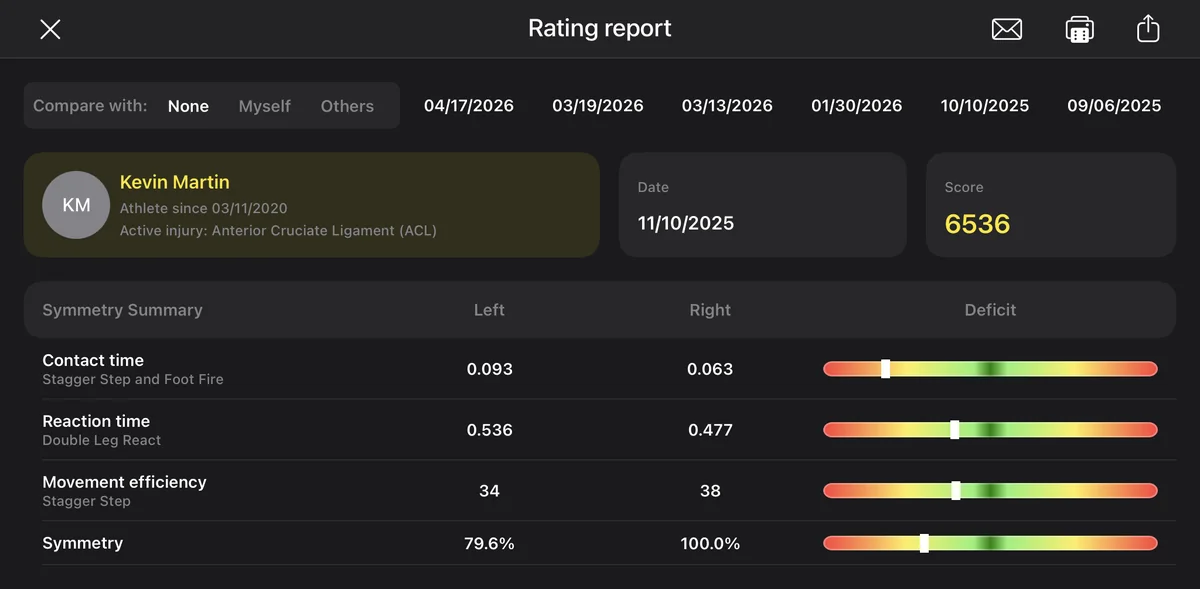
Symmetry is the piece a hit count can't show you.
What about pods that show letters and numbers?
Newer reaction lights display letters, numbers, or colors to force a choice.
Pods that flash a letter or a number do add a cognitive layer. The athlete has to read the stimulus and choose a response, not just hit whatever lights up. That is a real upgrade over a plain reaction light.
A light flashing a letter is still a visual stimulus the athlete responds to with a tap. That is stimulus-response, or choice reaction. It is good training. But it is not the same thing QuickBoard measures.
QuickBoard combines three things in one rep: reactive foot-target movement under full body weight, a decision made under load, and left-versus-right symmetry, all with automated clinical scoring. That is a different category, measuring what the lights cannot: symmetry, foot-reaction movement quality, and billable documentation.
A cognitive layer, but no symmetry
Read the letter or number, choose, and hit the pod. A real choice-reaction layer. Still a visual stimulus the athlete responds to, with no full-weight-bearing symmetry data and no clinical report.
Movement, decision, and symmetry together
Foot-target reaction under body weight, decision under load, and bilateral symmetry, scored automatically into a clinical PDF report. A different category of measurement.
Physical clearance and reactive readiness are not the same thing.
Advanced Neuromuscular Training Differentially Changes Performance on Visuomotor Reaction Tests and Single-leg Hop Tests in Patients with ACL Reconstruction
Independent research from TRIA Orthopedic Center used QuickBoard as the reaction test. After a five-week return-to-sport program, ACL patients improved more on hop tests than on reaction tests. Hop and reaction results did not move together. The authors conclude patients may still lean on extra mental effort to move, and they call for more dual-task challenges in rehab.
QuickBoard was the test in this study, not the training. This is the kind of measurement a reaction-light hit count does not capture, and it is why many programs add QuickBoard to their existing setup, not instead of it.
See the full research library →Reaction time and foot speed improved on QuickBoard.
Reaction Time and Foot Speed Gains From Reactive Training on QuickBoard
Active adults who trained on QuickBoard improved their reaction time and foot speed over a short training block. This is reaction training that produces measured change in the feet, not just a faster hit count.
After four weeks of foot speed and reaction training on the board, active adults new to agility training improved foot speed by 26% and reaction time by 19%. The training also transferred to a separate change-of-direction test that was not part of the program: about 0.45 seconds, roughly 7%, off an electronically timed course. The control group did not improve on any of the tests.
Reaction lights and QuickBoard both train reactions. QuickBoard scores the change, by limb, and documents it.
See the full research library →QuickBoard training beat agility ladder training on transfer.
Computerized Agility Training vs Agility Ladder Training in College Basketball Players
Randomized research with 64 men's college basketball players compared four weeks of computerized agility training on QuickBoard against agility ladder training. The QuickBoard group improved more on two tests run off the board: the Agility T-Test and reaction time inside a combined basketball skill test. The Agility T-Test was not one of the training drills.
The QuickBoard group also posted larger gains on the trained tasks themselves, foot speed and choice reaction time.
A memorized ladder pattern is a rehearsed drill. A randomized reactive protocol is a decision every rep. This research measured where that difference goes: sport-shaped tests run off the board.
See the full research library →Reaction time was the signal. Jump testing was not.
Division I Soccer: Reaction Time Tracked In-Season Fatigue. Vertical Jump Did Not.
University of Louisville researchers monitored Division I soccer athletes across a full competitive season. Vertical jump numbers held steady while athletes accumulated fatigue. QuickBoard reaction time was the differentiated signal.
Reaction time caught the in-season fatigue that jump testing missed. A measured reaction signal told the staff something the physical number did not.
These two measurements answer different performance questions. That is the point.
See the full research library →Three billable CPT codes, built from every assessment.
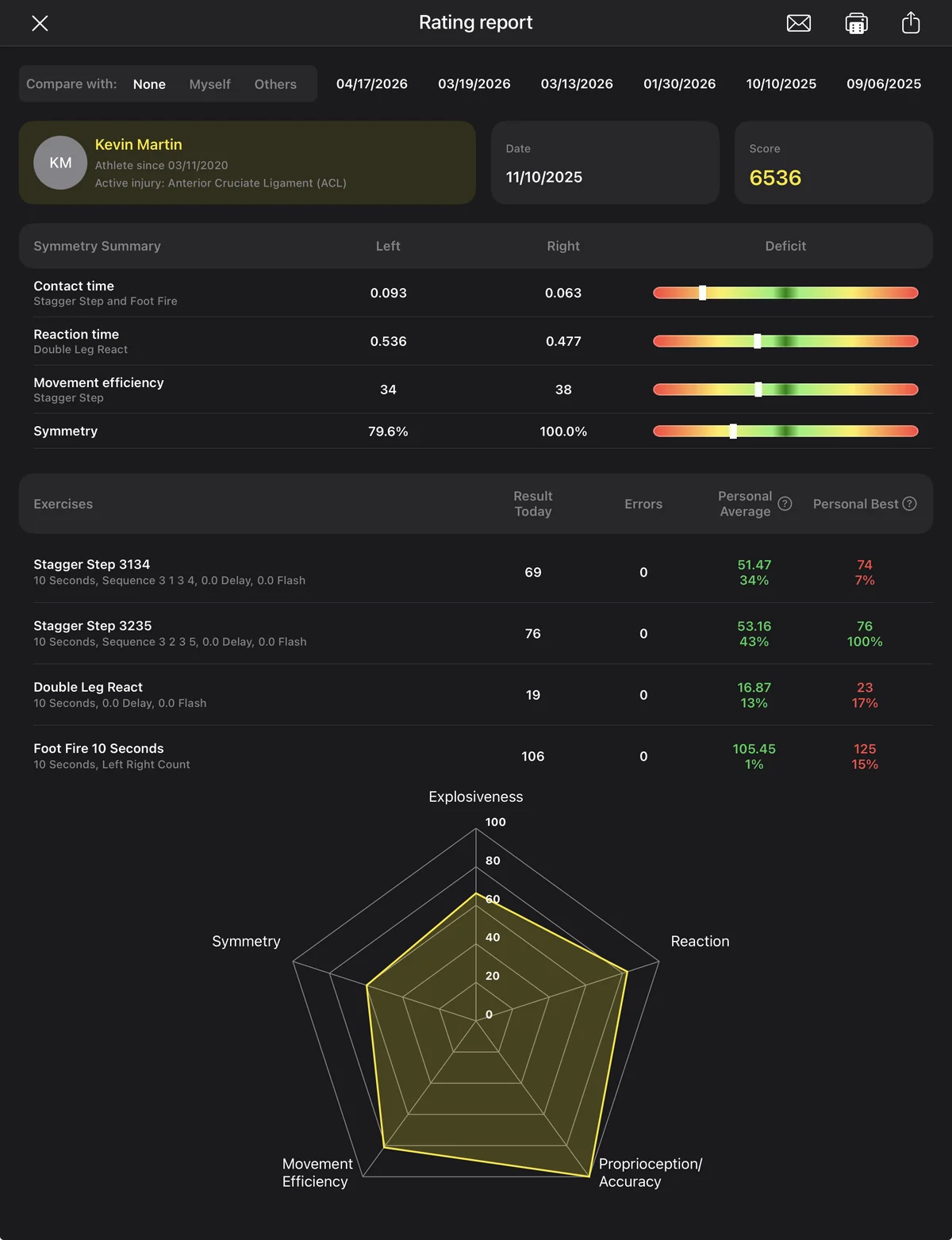
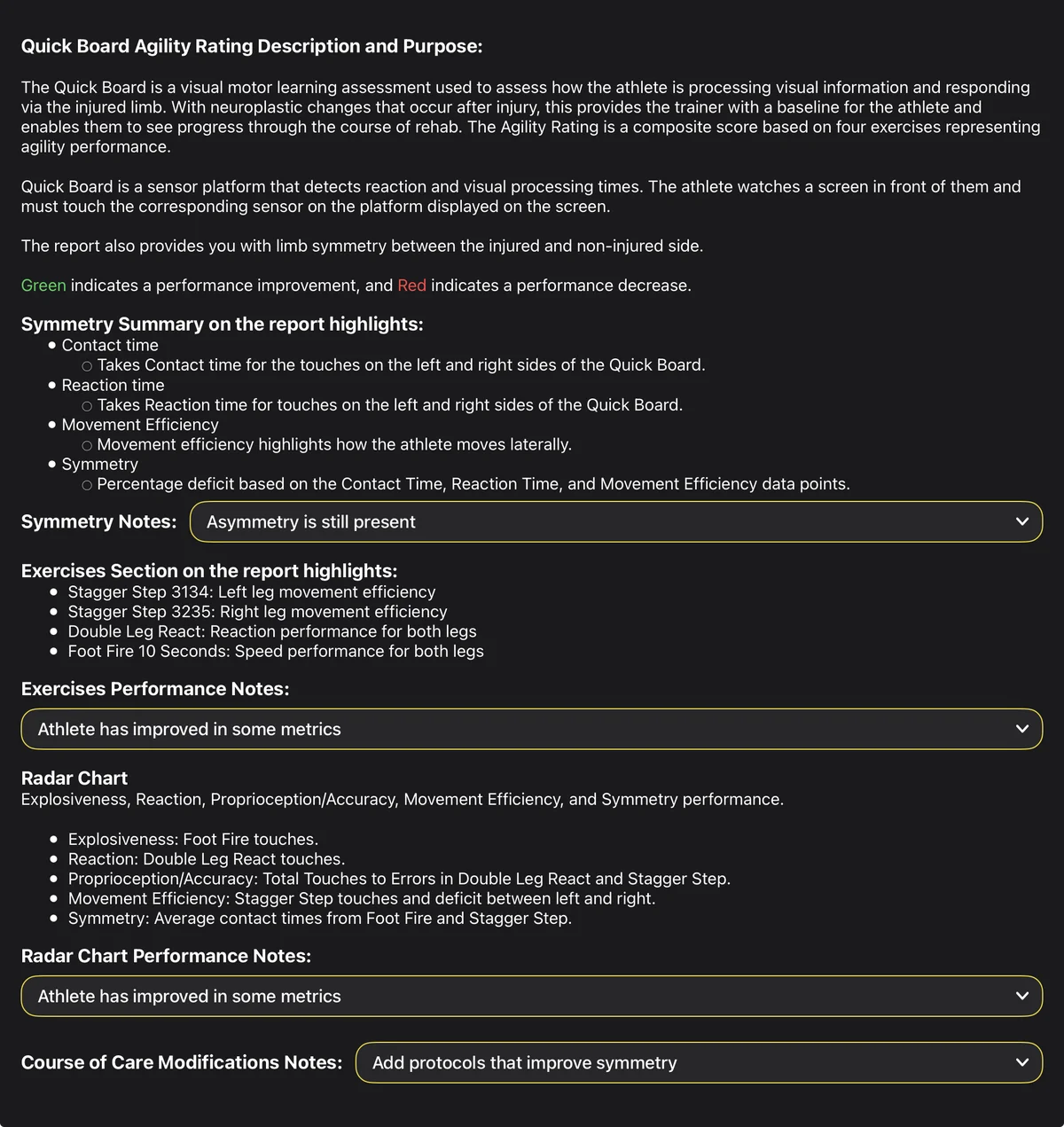
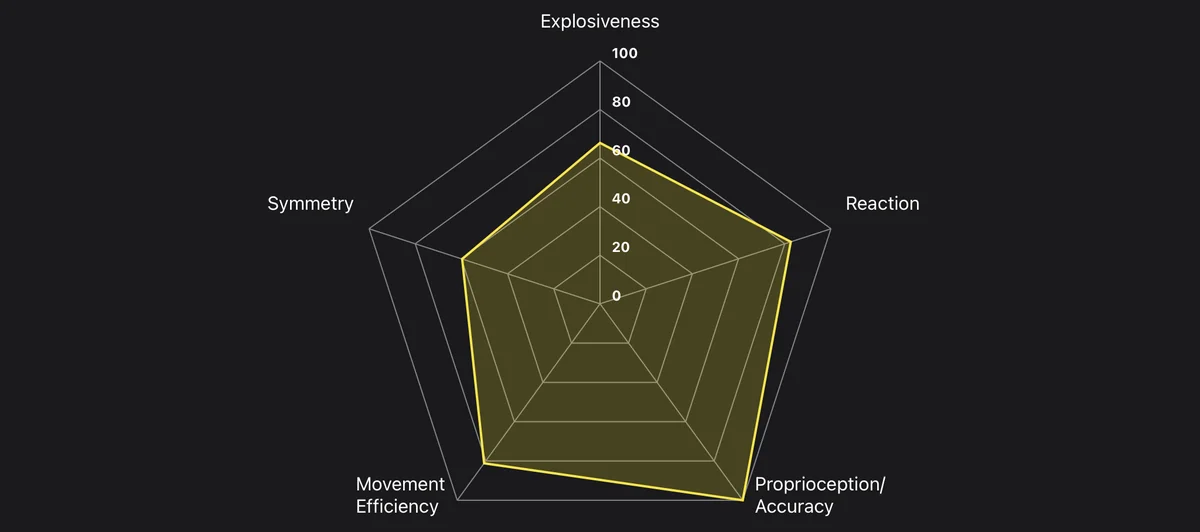
A reaction-light app produces a simple hit-count or reaction-time log. The QuickBoard Agility Rating auto-generates the CPT 97750 documentation as a PDF after every assessment.
Physical Performance Test
The Agility Rating assessment. The auto-generated PDF includes the Description and Purpose text required for billing. Billed in 15-minute increments.
Therapeutic Activities
Functional protocol sessions on the sensor board. Go/No-Go, Discrimination, Stroop, and reactive stepping protocols qualify.
Neuromuscular Re-education
Neuro rehab and dual-task protocols. Pre-populated billing descriptions generated automatically after every session.
From a clinician who quantifies RTS readiness.
The Quick Board is a game-changer for us. By tracking baseline data, we know if an athlete is trending in the right direction AND if they need more attention in certain areas. We use this for concussion, knee, ankle, hip, core, and shoulder rehab. One of the best pieces of technology to assist in quantifying return to play readiness.

The measurement layer a hit log does not give you.
QuickBoard is recommended technology for neurocognitive and neuromuscular rehabilitation. It ships with pre-built protocols mapped to the four stages of ACL rehabilitation: acute, sub-acute, functional, and return-to-sport.
Reaction lights run fast visual drills. QuickBoard adds the measurement layer: foot-reaction movement under body weight, decision under load, and bilateral symmetry. It delivers that layer with automated protocol running, left-versus-right symmetry tracking, and PDF reports after every session.
This is not about replacing the pods. It is about answering the question a hit log cannot answer.
Fast, portable reaction drills
Simple visual stimulus and response. Hit counts and basic reaction-time logs. Flexible spacing, seated or standing, at any stage of a rehab or a training block.
Measured reactive readiness under load
Foot-target reaction under full body weight. Decision speed under cognitive load. Bilateral symmetry during reactive stepping. Automated scoring and PDF reports.
See QuickBoard in action.
Common comparison questions.
No. Portable reaction lights and QuickBoard answer different questions. Reaction lights run fast visual reaction drills with the target on the ground. QuickBoard measures foot-reaction movement quality under full body weight, decision speed under cognitive load, and bilateral symmetry, then auto-generates a clinical PDF report. These are different categories of measurement. Many programs use both.
Yes. Pods that display letters, numbers, or colors add a real cognitive layer. But a light flashing a letter is still a visual stimulus the athlete responds to with a tap. QuickBoard measures something different: reactive foot-target movement under full body weight, decision under load, and left-versus-right symmetry, with automated clinical scoring. Reaction lights do not measure bilateral symmetry or produce billable documentation.
No. Reaction-light apps give simple hit-count and reaction-time logs. They do not compare the left leg against the right under body weight. QuickBoard captures bilateral symmetry during reactive stepping and reports the gap. For return-to-sport decisions after injury, that left-versus-right reaction data is the central thing reaction lights cannot give you.
Reaction lights and QuickBoard answer different questions. Floor pods pull the athlete's gaze to the ground for a fast visual reaction drill, then log a hit count and reaction time. QuickBoard keeps the eyes up on a screen while the feet react under full body weight, and it adds decision speed under cognitive load, left-versus-right symmetry on every rep, and an automated clinical PDF report after every session. Many programs use both.
Keep reading
- How QuickBoard works next to force plates. For programs that already own a plate.
- Every QuickBoard comparison on one page
- How the Agility Rating is scored
- HD Sensor Board and HD Pro specs and pricing
See the Clinical Workflow in 15 Minutes
We walk your team through the reaction and symmetry data, show real patient reports, and answer questions about how QuickBoard fits alongside your existing reaction-light setup.
Explore the published research →