Training Methodology

How QuickBoard works.

QuickBoard is a cognitive-motor training system built on external focus motor learning, layered cognitive demand, and reactive movement on a sensor board. The Agility Rating turns that training model into a composite score clinicians can track.

QuickBoard's training methodology combines external focus motor learning, dual-task cognitive demand, and reactive movement on a sensor board. The visual stimulus and live movement feedback appear on the iPad screen while the seven sensors capture touches on the floor, so the athlete trains with attention on the screen rather than on the feet. The Agility Rating is the assessment built around this model: a composite score from 0 to 10,000 from four scored exercises across five dimensions, billable as CPT 97750.

Training Model

External focus is the primary training mechanism.

The screen carries the stimulus and the feedback. The board captures the movement. Proprioception is a downstream benefit.

Wulf 2001

Constrained action hypothesis: attention on the target beats attention on the body.

Wulf's work on attentional focus (2001, Quarterly Journal of Experimental Psychology) proposed that attending to the effect of a movement, a target or an outcome, leaves movement control to run automatically, while attending to the body part interferes with it. Many studies since have found better performance under an external cue than an internal one. A 2024 reanalysis in Psychological Bulletin corrected the pooled estimates for publication bias and found the averaged advantage much smaller than the field assumed, so we treat external focus as a design principle rather than a settled effect size. The part that holds up best is the one QuickBoard is built around: asking someone to watch their own feet makes movement worse. QuickBoard places the stimulus and live feedback on the iPad screen, so attention stays external while the athlete moves on the sensor board.

Bonnette 2020

Real-time visual feedback carried over to a different task, in a small pilot.

Bonnette et al. (2020), a small pilot with 11 high school volleyball players and no control group, found one session of squat training with live visual feedback carried over to some drop-jump landing measures: 3 of 7 measures improved, and only the change in knee extensor load held up after correcting for multiple comparisons. QuickBoard is not named in the study.

Practical note

Patients can look at their feet. The screen is the reason they don't.

The QuickBoard sensor board does not physically prevent a patient from looking down. The iPad's real-time visual stimulus and live movement feedback are designed to keep attention on the screen during reactive drills, where the cognitive cue and the movement target both appear on screen. That is what makes the training external in the motor-learning sense.

Real-time motivation

The progress bar runs you against your best self.

During every exercise, a live progress bar shows how the athlete or patient is doing in real time relative to their personal best for that drill. Like running a sprint against your own best time, the visible bar drives motivation and intensity, which produce better outcomes than untimed effort.

Live progress bar advancing against the personal best for the exercise.
Cognitive Demand

Reactive movement, layered with cognitive load.

The board adds cognitive tasks on top of reactive motor demand. The four cognitive tasks below are how QuickBoard scales the cognitive component of training.

Cognitive Task 1

Standard reaction

A visual stimulus appears on the iPad screen. The athlete reacts by stepping on the corresponding sensor on the board. Reaction time is captured at millisecond precision for each leg. This is the Hick's Law floor: single stimulus, single response. Discrimination and Stroop layer above to lengthen processing and surface deficits (University of Memphis Hick's Law research).

Cognitive Task 2

Go / No-Go

Response inhibition. The athlete reacts to one cue and suppresses the response to another. Go/No-Go tests the ability to stop a planned motor response, which is the same demand placed on athletes when a defender shifts mid-cut or a stimulus changes mid-step.

Cognitive Task 3

Discrimination (Array in app)

The athlete distinguishes between similar visual stimuli and reacts only to the correct one. This trains visual discrimination under motor load. The in-app label is Array; the clinical description is Discrimination.

Cognitive Task 4

Stroop variants

Cognitive flexibility and set-shifting. The athlete responds based on a rule that conflicts with an automatic response, which forces top-down cognitive control over motor execution. Stroop variants train the executive component of cognitive-motor performance.

University of Memphis

Reaction time scales predictably with stimulus complexity.

Hick's Law research at the University of Memphis showed that reaction time scales predictably with the number and complexity of stimuli the athlete must process. That is the engineering basis for graded cognitive-task progressions on the board: simple reaction is the floor; Discrimination and Stroop add layers that lengthen processing time and surface deficits.

The Agility Rating

One score. Four exercises. Five dimensions. Under two minutes.

The Agility Rating is the composite assessment that turns the training model into a measurable score. It is billable under CPT 97750 (Physical Performance Test) with the Description and Purpose pre-populated on the auto-generated PDF report.

Exercise 1

Stagger Step (right and left)

Lateral stepping on each side separately. The right vs left difference produces the bilateral deficit penalty inside the composite score. Drives the Movement Efficiency and Symmetry dimensions.

Exercise 2

Double Leg React

The athlete reacts to visual stimuli with both legs at full body weight. Touch count drives the Reaction dimension; reaction time per leg in milliseconds is reported in the Symmetry Summary.

Exercise 3

Foot Fire (10 seconds)

Maximum-rate alternating foot contacts for 10 seconds. Drives the Explosiveness dimension. Contact time per leg is also captured for the Symmetry calculation.

Score range

0 to 10,000 across five dimensions.

The five dimensions are Explosiveness, Reaction, Proprioception/Accuracy, Movement Efficiency, and Symmetry. The composite score reflects the weighted contribution of each. The score can go down between sessions if exercise results drop or if the Stagger Step deficit between right and left grows. That is by design; the rating is an honest snapshot, not a number that only increases.

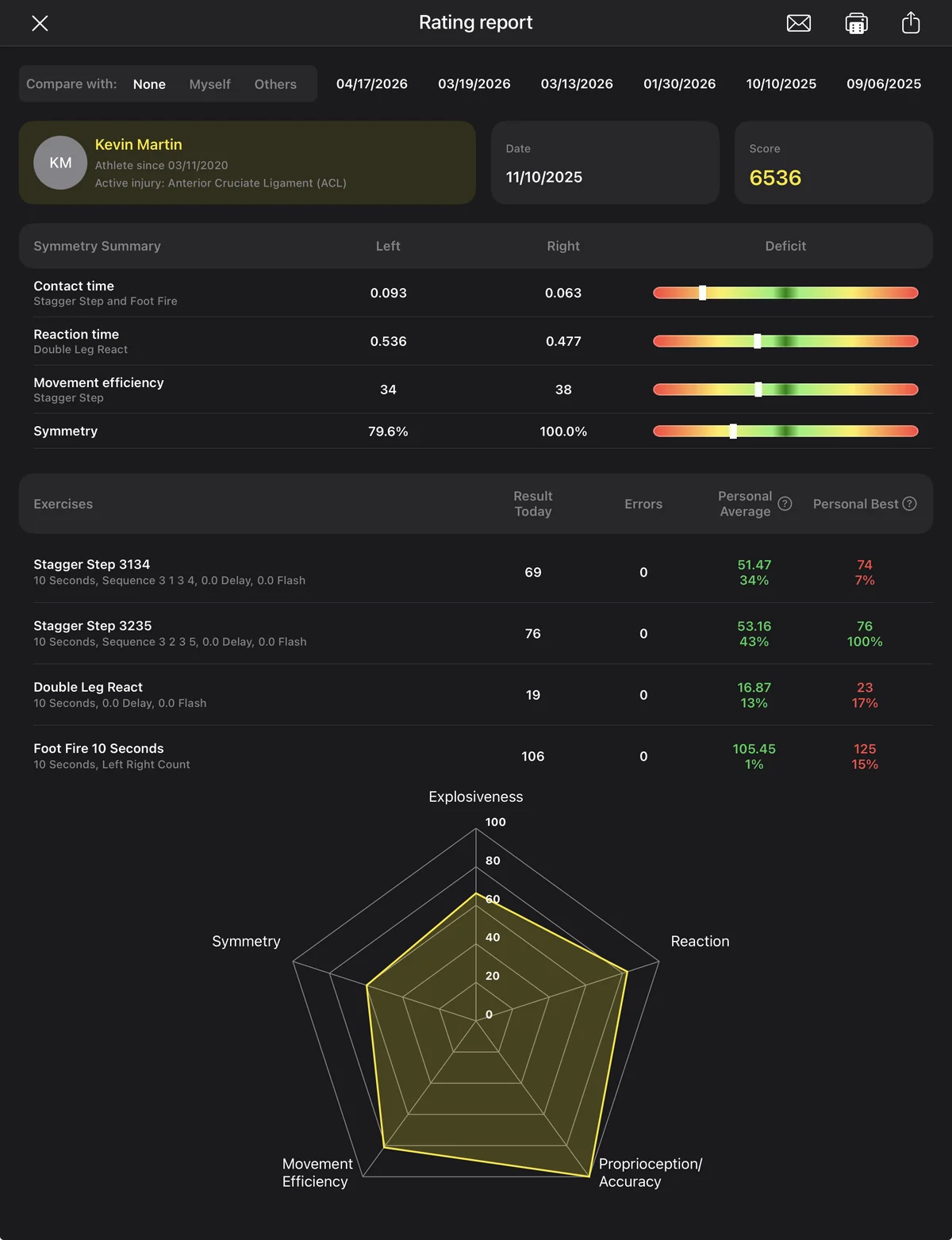
The full QuickBoard Agility Rating Report PDF showing the composite score, radar chart, Symmetry Summary, and exercise results
The Agility Rating Report auto-generates as a PDF and is exported to the clinician's email after the session.
HowTo

Run an Agility Rating assessment.

Five steps, under two minutes of athlete time. The clinician sets up; the system rehabs and assesses; the report exports automatically.

1
Pull the patient profile

Open the QuickBoard app on the iPad and select the patient or athlete profile. The profile shows Best and Last results before each exercise so the upcoming session is contextual.

2
Athlete steps onto the sensor board

The athlete steps onto the sensor board. The visual stimulus and real-time movement feedback appear on the iPad screen, keeping attention on the screen while the sensors register touches on the floor.

3
Run the four scored exercises

Stagger Step (right and left), Double Leg React, and Foot Fire. Total athlete time is under two minutes. Touches and Errors are counted during each exercise.

4
Review the auto-generated PDF report

The Agility Rating Report auto-generates as a PDF and is exported to the clinician's email after the session. The report includes the composite score, the five-dimension radar chart, the Symmetry Summary with reaction time per leg, and individual exercise results with personal best and personal average comparisons.

5
Recommend the targeted workout

The app identifies the weakest of the five dimensions and recommends the matching workout type at the correct progressive level. The clinician confirms or substitutes based on clinical judgment.

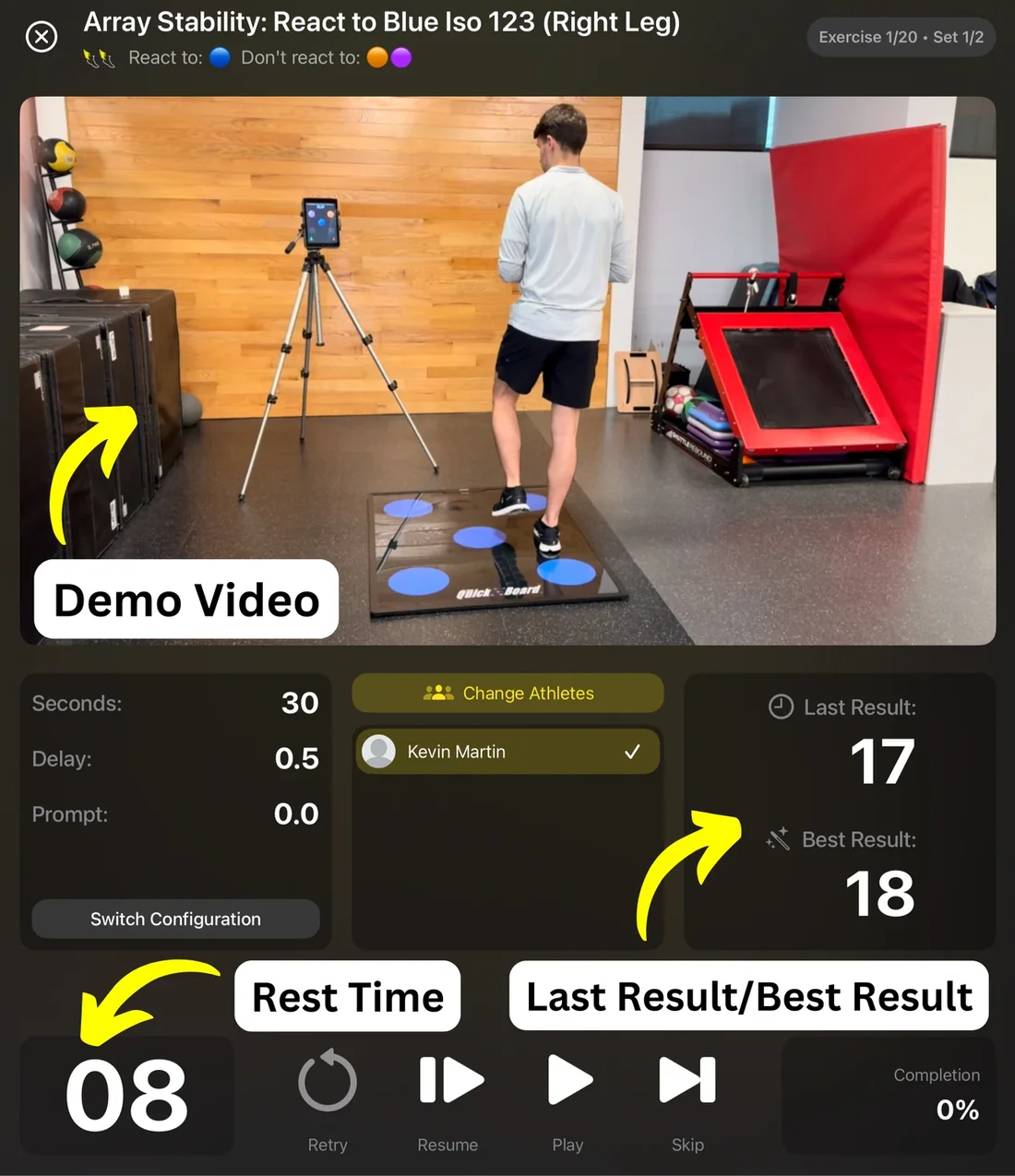
QuickBoard app exercise screen with the demo video, the rest timer between exercises, and the last and best result readouts labeled
The exercise run screen: the demo video, the rest timer between exercises, and last and best results, all on the iPad.
Five Dimensions

What each dimension measures.

Each axis maps a specific exercise output. Each dimension also maps directly to a recommended workout type.

Dimension 1

Explosiveness

Driven by Foot Fire touch count over 10 seconds. Higher touches reflect faster, more explosive lower-body cycling. Low scores recommend Speed Workouts.

Dimension 2

Reaction

Driven by Double Leg React touch count plus reaction time per leg in milliseconds. The Symmetry Summary in the report shows the right-vs-left reaction-time breakdown. Low scores recommend Reaction Workouts.

Dimension 3

Proprioception / Accuracy

Calculated from Touches and Errors counted during each exercise. Fewer errors relative to total touches reflects better body awareness in space. Low scores recommend Stability Workouts.

Dimension 4

Movement Efficiency

Driven by Stagger Step touches on each leg and the deficit between right and left. More touches with smaller deficit reflects better lateral movement efficiency. Low scores recommend Movement Workouts.

Dimension 5

Symmetry

Derived from average contact times in Foot Fire and Stagger Step plus reaction time per leg in Double Leg React. Even contact and reaction across right and left produces a higher Symmetry score. Critical for unilateral injury, post-op return-to-sport, and hemiparetic neuro presentations.

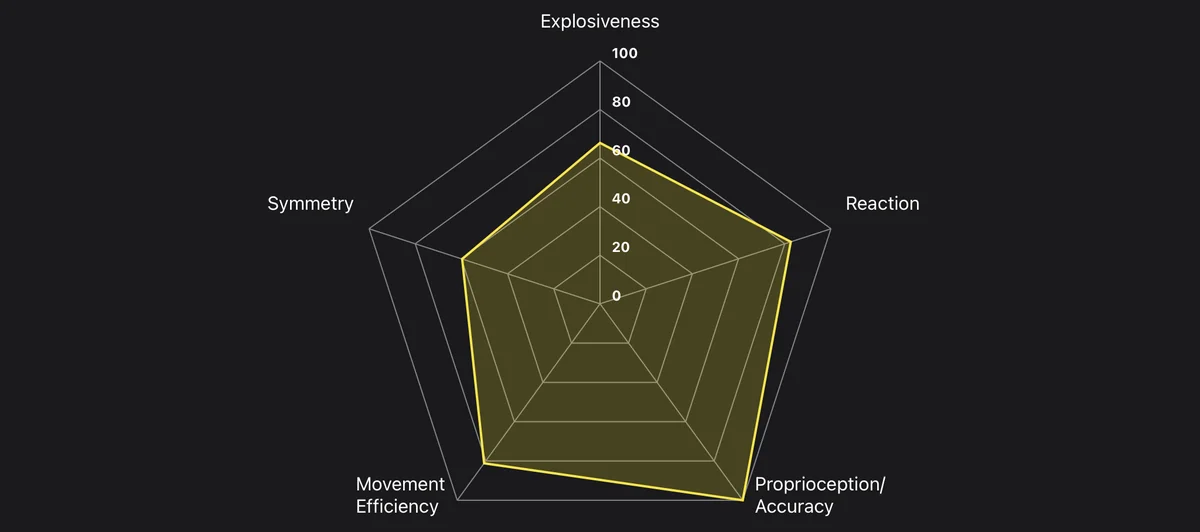
QuickBoard Agility Rating five-dimension radar chart plotting explosiveness, reaction, proprioception, movement efficiency, and symmetry
The five-dimension radar chart shows each axis at a glance, so the weakest dimension is easy to spot.
Targeted Workouts

The rating diagnoses. The workout prescribes.

The Agility Rating is not just a score. The app reads the weakest dimension and recommends the workout that targets that gap, at the right progressive level for the athlete. Twelve total Agility-Rating-recommended workouts (four types times three levels), all on the QuickBoard sensor board.

If Explosiveness is low

Speed Workouts

Three progressive levels. Foot Fire focused.

If Proprioception is low

Stability Workouts

Three progressive levels. Reduce errors, build body awareness on the board.

If Movement Efficiency is low

Movement Workouts

Three progressive levels. Stagger-Step-driven lateral patterning.

If Reaction is low

Reaction Workouts

Three progressive levels. Visual stimulus to motor response under cognitive load.

Twelve workouts is a fixed grid: four types across three levels. The full clinical protocol library on the sensor board is separate.

Captured Metrics

What QuickBoard captures during every session.

The data backing the rating, the report, and the clinical decision.

Reaction

Reaction time per leg in milliseconds

Captured in Double Leg React and reported in the Symmetry Summary as right vs left in milliseconds.

Contact

Ground contact time per leg

Captured in Stagger Step and Foot Fire. Shorter and more even contact between right and left reflects better symmetry.

Symmetry

Bilateral symmetry

Computed from contact time and reaction time across right and left. Reported as a single Symmetry score on the radar chart and as numeric deltas in the Symmetry Summary.

Accuracy

Accuracy from Touches and Errors

Touches and Errors are counted during each exercise; accuracy is calculated from that ratio. Drives the Proprioception/Accuracy dimension.

Jump Testing (standard)

Air time, jump height, reactive strength index

Standard outputs from vertical and drop jump testing on the board. Captured without additional data entry.

Jump Testing (with body weight)

Impulse, average force, peak power

When body weight is entered in the patient or athlete profile, the report adds impulse, average force, and peak power to the standard jump outputs.

Foundational Research

The methodology citations.

The peer-reviewed work behind the QuickBoard training model. Clinical outcome citations on neurocognitive and neuromuscular rehabilitation, including Chmielewski (IJSPT 2024), live on the research page.

Wulf · 2001

Attentional focus and motor learning. Constrained action hypothesis (Wulf, McNevin, and Shea, 2001, Quarterly Journal of Experimental Psychology).

Across many studies, an external focus on the effect of a movement has produced better performance than an internal focus on body mechanics. A 2024 publication-bias reanalysis found the averaged advantage smaller than previously reported, so this is cited as the design principle behind QuickBoard's screen-as-stimulus, board-as-platform training model rather than as a settled effect size.

University of Memphis · Hick's Law work

Reaction time and stimulus complexity. Research at the University of Memphis on reaction time scaling under increasing stimulus load.

Reaction time scales predictably with the number and complexity of stimuli. The empirical basis for graded cognitive-task progressions on the board, from standard reaction to Discrimination and Stroop variants.

Bonnette et al. · Journal of Sports Science and Medicine · 2020

A technical report on the development of a real-time visual biofeedback system to optimize motor learning and movement deficit correction. Published in the Journal of Sports Science and Medicine. From Cincinnati Children's Hospital Medical Center, the University of Cincinnati and UNC Chapel Hill. Eleven healthy female high school volleyball players each did one lab session, with no control group. The authors disclose potential royalties from the feedback system. QuickBoard is not named in it.

The athletes did 40 bodyweight squats with a live display tracking four ACL injury-risk measures. Afterward, they squatted closer to the target pattern, even with the display off. In drop jumps, 3 of 7 landing measures improved. After a correction for running many tests, only the drop in knee extensor load held up. The authors say that without a control group, they cannot be sure the feedback caused the gains.

Galpin et al. · JSCR 2008 · QuickBoard Study

Transfer to a separate change-of-direction test. Four weeks of reaction and foot-speed training on the board, in active adults new to agility training.

Eleven adults trained foot speed and choice reaction on the board for four weeks; twelve others did no training. The trained group improved foot speed by 26% and reaction time by 19%. The training also transferred to a separate change-of-direction test that was not part of the program: about 0.45 seconds, roughly 7%, off an electronically timed course. The control group did not improve on any of the tests.

FAQ

Methodology questions.

External focus is a motor learning model in which the athlete attends to the effect of a movement (a target on a screen, an outcome) rather than to the body part producing the movement. Wulf's constrained action hypothesis (2001) proposes that an external focus lets movement control run automatically. Across many studies an external focus has produced better performance than an internal focus, though a 2024 publication-bias reanalysis found the averaged advantage smaller than the field assumed. QuickBoard implements this by placing the visual stimulus and live movement feedback on the iPad screen while the sensors capture touches on the floor.

A composite score from 0 to 10,000 built from four scored exercises (Stagger Step Left, Stagger Step Right, Double Leg React, Foot Fire) across five dimensions (Explosiveness, Reaction, Proprioception/Accuracy, Movement Efficiency, Symmetry). The Stagger Step right vs left difference applies the bilateral deficit penalty. See the full Agility Rating page.

Under two minutes total for the four exercises. The Agility Rating Report auto-generates as a PDF and is exported to the clinician's email after the session. Billable under CPT 97750 in 15-minute increments.

Discrimination is the prospect-facing description of the cognitive task: the athlete distinguishes between similar visual stimuli and reacts only to the correct one. Array is the in-app label for the same task. Use Discrimination when describing the methodology; Array refers to the icon and label inside the QuickBoard app.

The app reads the weakest of the five dimensions and recommends the matching workout type (Speed for Explosiveness, Stability for Proprioception, Movement for Movement Efficiency, Reaction for Reaction) at one of three progressive levels. That gives twelve total Agility-Rating-recommended workouts, all of which require the QuickBoard sensor board.

Reaction time per leg in milliseconds, ground contact time per leg, bilateral symmetry, and accuracy calculated from Touches and Errors counted during each exercise. Jump testing produces air time, jump height, and reactive strength index by default; with body weight entered in the profile, impulse, average force, and peak power are also reported.

Yes. The training model rests on peer-reviewed motor learning research (Wulf 2001) and the University of Memphis Hick's Law work on reaction time scaling with stimulus complexity. The QuickBoard sensor board is recommended technology for neurocognitive and neuromuscular rehabilitation. The full peer-reviewed citation lives on the research page.

15-Minute Virtual Demo

See it before you buy.

A QuickBoard rep walks your team through one or two pre-built protocols, runs an Agility Rating session, and shows the auto-generated reports.